Industrial Security Gateways for Secure OT/IT Connectivity
A security gateway sits at the boundary between the production network (OT) and IT or the cloud and controls every data flow between them. It allows only approved connections, encrypts the transmission and shields the plant from direct access. In the IoT stack, it ensures that plants in critical or regulated environments are connected securely.

Security Manager IoT, CLAAS KGaA mbH
1 user from the network has already implemented this
Talk implementation with other users
In the user group, 300+ users discuss every month what worked in their projects and what they would do differently today. No vendors in the room, honest exchange under NDA.
Who offers it
Security gateway in practice
2 manufacturers from our partner network with 10 solution examples. Those with the most documented use in this category come first.
- Get in touch with ECOS Technology GmbH

ECOS Technology GmbH
Security gateway3 solution examples 
secunet Security Networks AG
Security gateway7 solution examples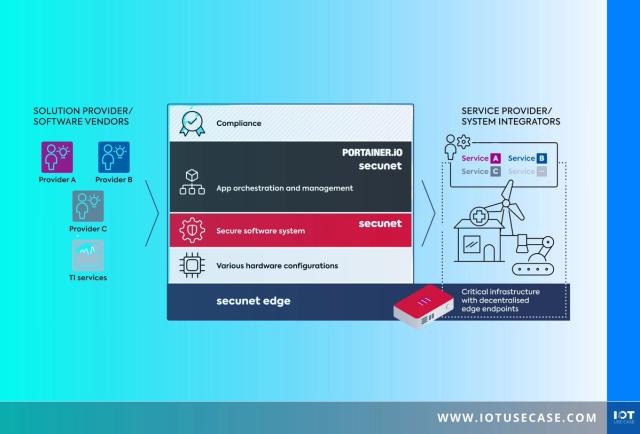





 Fraud and Loss Prevention
Operating distributed systems securely: with containers and edge platform
Aug 20, 2026Read more →
 Fraud and Loss Prevention
NIS-2 gap analysis at a machine manufacturer strengthens IT security
Nov 13, 2025Read more → Digital Documentation
Rethinking confidential communication – with encrypted business messengers
Jul 3, 2025Read more →






What it is used for
What they are used for, and with what
Based on these manufacturers' solution examples: the most common use cases and the technologies their solutions speak.
What to look for
What a security gateway does
A security gateway sits at the boundary between the production network (OT) and the office or cloud network (IT) and controls every data flow between the two. It allows only defined connections, terminates external connections on the gateway itself instead of passing them into the plant, and secures transmission with encryption and certificates. Many devices combine a firewall, VPN, inspection of industrial protocols and logging. Some also allow applications to run in an isolated environment on the device.
A special case is the data diode: it physically allows data to pass in one direction only, for example from the control system to an analytics platform, and technically rules out any return channel into the plant.
Security gateway, router or edge device?
The primary reason for buying one is OT/IT separation with a secure connection. A router connects networks and often includes a basic firewall, but it is designed for connectivity. An edge device processes data on site. A security gateway is bought when plants in critical or regulated environments need to be connected and verifiable security is required, for example by operators of critical infrastructure, in energy supply or in the chemical and pharmaceutical industries.
What to look for when choosing one
Key criteria are certifications and approvals, such as those from the German Federal Office for Information Security (BSI), alignment with the IEC 62443 series of standards for the security of industrial automation systems and, depending on the sector, requirements from the EU NIS2 directive. Add to that the supported industrial protocols, the ability to segment the network into zones and conduits, central management including certificate handling, and long-term security updates.
Implementation usually starts with an inventory: which plants communicate with which systems, and which connections are actually needed? These answers become the rules the gateway enforces. A step-by-step approach, one plant at a time, keeps ongoing operations stable.
From the network, secunet and ECOS Technology offer solutions for connecting industrial plants securely. In solution examples, security gateways often protect remote maintenance and data extraction from plants that must not be connected directly to the internet.
Frequently asked questions about security gateways
What is a security gateway?
A security gateway is a device at the boundary between two networks that inspects all traffic and allows only approved connections. In industrial settings, it separates the production network from IT and the internet, encrypts transmission and shields controllers from direct access. It combines connectivity with verifiable security for plants that must meet strict requirements.
What is a data diode?
A data diode is a security device that physically lets data travel in one direction only. Usually this is done with an optical link that has only a transmitter on one side and only a receiver on the other. Measured values can flow from a plant to IT or the cloud, while any access back into the plant is ruled out by design.
How does OT network segmentation work?
OT network segmentation divides the production network into zones with similar protection needs, such as individual lines, the control system and the office network. Between the zones, security gateways or firewalls control which connections are allowed. An attack or malware infection then stays confined to one zone. IEC 62443 describes this principle as zones and conduits.
What is the Purdue model?
The Purdue model is a reference model that divides industrial networks into levels: from field devices through controllers and control systems up to production management and enterprise IT. Between OT and IT sits a buffer zone, the industrial DMZ. Security gateways are typically placed at these transitions and control which data may flow between the levels.
What does IEC 62443 mean for security gateways?
For security gateways, IEC 62443 mainly calls for access control, authentication, data integrity and confidentiality, and separation of the network into zones. The series covers the security of industrial automation systems. Part 4-1 defines a secure development process for manufacturers, and part 4-2 sets technical requirements for components. Certification against these parts makes it easier to demonstrate compliance to auditors.
On the podcast
Episodes with these manufacturers and their customers.
- #172NIS2 compliance and cyber security: experts from secunet and the cyberintelligence.institute share insightscyberintelligence.institute · secunet Security Networks AG · Jun 11, 2025Listen
- #147Securing and Efficiently Managing IoT Devices – Avoid Costly Errors and Security Risksconplement AG · ECOS Technology GmbH · Oct 24, 2024Listen
- #146CLAAS - Digital agriculture with secure identities for networked machinesCLAAS KGaA mbH · secunet Security Networks AG · Oct 23, 2024Listen
Related categories
More product categories on the same layer and the technologies solutions in this category connect through.