



Industrial edge infrastructures have to reconcile two opposing requirements: long-lived machines and stable production networks on one side, frequent software changes, security updates and new applications on the other. Softing Industrial Automation’s edgeNode Portainer therefore strictly separates hardware and software: the compact DIN-rail edge device ships with the Portainer Agent preinstalled and can be managed centrally from day one.
Companies can deploy applications centrally, update them across sites and know at any time which software version is running on which device. For machine connectivity, Softing’s separately licensed, containerized connectivity software SDEX Suite can be added. The hardware stays in the control cabinet for years, while the software keeps evolving.
The challenge: long-lived equipment needs flexible edge software
Companies need production data for higher-level applications such as MES, ERP or PLM. The data comes from controllers and machines that often stay in service for many years. In the past, an edge device was often a static, standalone solution: installed at one site, running a single application such as a local dashboard and then left unchanged for years. Today, several applications are expected to run on the same infrastructure, more will be added later, and security updates have to be installed regularly.
This interface between OT (operational technology) and IT is often called the industrial edge. It consists of hardware that connects to controllers and sensors, connectivity software, management tools and, where needed, applications for data processing. Small and mid-sized manufacturers in particular have extensive know-how about their OT infrastructure but only limited IT resources. These are often not enough to evaluate, build and operate an industrial edge made up of individual components from different vendors over the long term. On top of that, many companies run a mix of equipment, for example Siemens and Wago controllers in one plant and Rockwell and Beckhoff in the next. At the same time, they do not want to be tied to either a cloud provider or a major automation vendor.
No one feels responsible for software maintenance
Every edge device also comes with software that has to be maintained: versions need to be tracked, security patches installed and configurations kept up to date. In practice, this is often nobody’s job. Once the installation is complete, the manufacturer and the system integrator have finished their work, IT often has no access to the OT network, and OT does not see software versions as its responsibility. Without central management, the software on the devices starts to drift apart shortly after installation. With three devices, this version drift is manageable. With thirty or three hundred, it becomes a risk, and one that surfaces as soon as an audit asks which version is running on which device.
Isolated production networks make updates difficult
Production networks operate under different conditions than many consumer IoT systems. Industrial systems and control cabinets often have no direct internet connection by design. A vendor therefore cannot simply push security updates from its cloud to every device, because updates have to follow the operator’s network and security policies. Adding remote management after the fact is complex: it often requires firewall openings that the OT security architecture deliberately prevents, lengthy change management approvals or on-site visits by specialists. Replacing hardware is expensive as well, because every intervention in the control cabinet means a technician, an internal work order and updated wiring diagrams.
At the same time, regulatory requirements are increasing. The NIS2 Directive requires operators to monitor and maintain their connected infrastructure and to patch it within defined timeframes. Without a central management layer, the patch may exist, but there is no reliable way to get it onto every device.
Containers provide a technically sound foundation: applications are packaged with all their dependencies into standardized units, so they can be deployed, updated and replaced independently of the hardware. Full Kubernetes platforms such as Red Hat OpenShift or SUSE Rancher, however, are often oversized for the industrial edge and do not match the skill sets of OT-driven organizations. What is needed is a lightweight solution for managing containers centrally without requiring teams to become Kubernetes experts.
Challenges at a glance
- •Long-lived production hardware meets rapidly changing software requirements.
- •Limited IT resources make it hard to select, build and operate an industrial edge from individual components.
- •Without central management and clear responsibilities, software versions on distributed devices drift apart.
- •Isolated production networks and NIS2 call for secure, auditable update processes.
The solution: containers separate long-lived hardware from flexible software
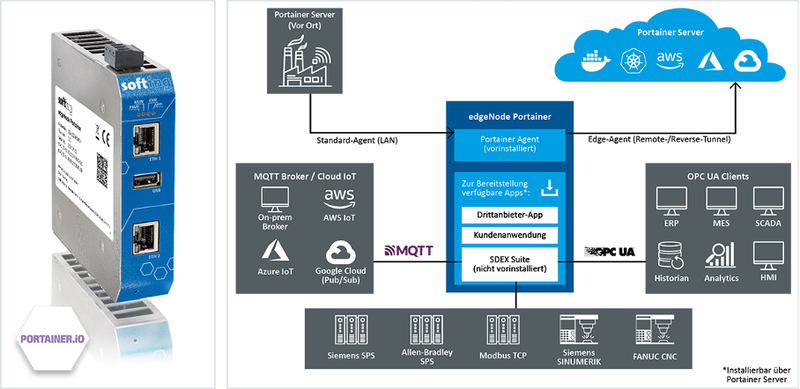
edgeNode Portainer from Softing Industrial Automation, a subsidiary of Softing AG, offers an entry point into container-based architectures for the industrial edge. It combines industrial-grade hardware with the preinstalled Portainer Agent and a GUI for easy device management. Softing has specialized in industrial communication for more than 40 years, was involved in developing Profibus and was one of the first vendors to containerize machine connectivity.
The solution is aimed especially at industrial companies where OT managers want to introduce new edge applications but have only limited IT resources. They get a coordinated solution from a single source: Softing supplies the hardware, the connectivity software and, as a reseller, the Portainer licenses as well. That means one point of contact for purchasing and support instead of several suppliers who shift responsibility onto each other when something goes wrong.
Open edge platform connects hardware and applications
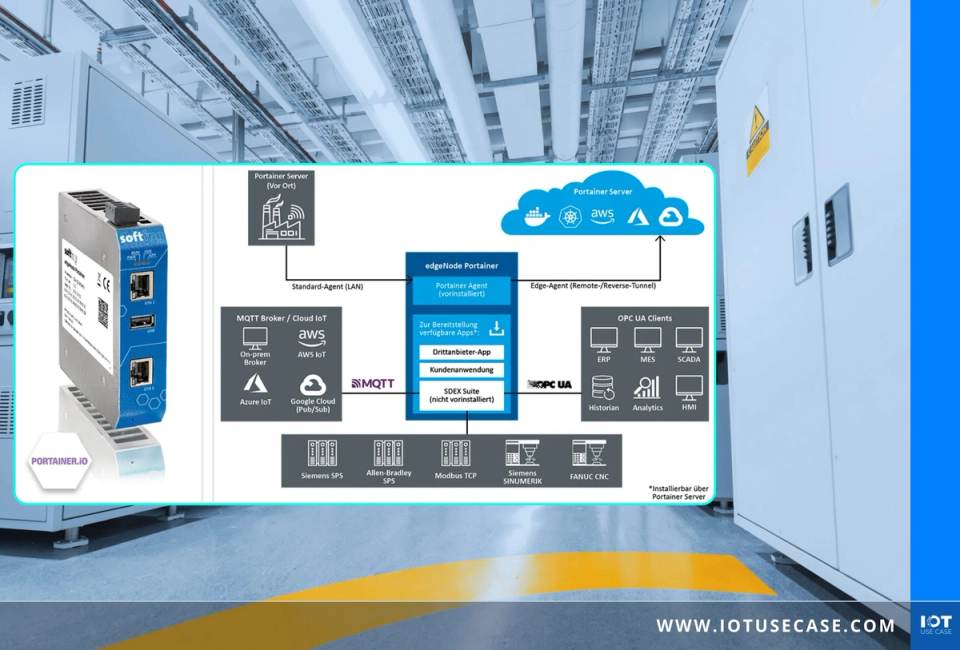
edgeNode Portainer is an open platform based on a 64-bit ARM architecture: in addition to Softing components, it can run any Docker-based applications from other vendors. Softing sees itself as an independent specialist for the layer between automation and IT. The solution supports controllers from different manufacturers as data sources and can connect to numerous cloud platforms as data destinations.
The device mounts on a DIN rail in the control cabinet. A typical industrial edge solution consists of four elements:
- Softing’s industrial-grade edge hardware with two network ports.
- The Portainer Agent for central management of containerized applications.
- Softing’s SDEX Suite (Shopfloor Data Exchange Suite), formerly edgeConnector, as separately licensed, containerized software for machine connectivity.
- Optional third-party components, such as an MQTT broker from Cedalo, databases like InfluxDB or visualization with Grafana.
The hardware is deliberately designed with spare capacity. Because every intervention in the control cabinet takes considerable effort, additional applications can be added later without replacing the device. Where an industrial PC was previously used only for machine connectivity, the edgeNode can replace it at lower cost. It is not intended for large-scale applications, however: ERP or MES systems at the edge need more computing power, memory and scalability and belong on industrial PCs or rack systems. The edgeNode is a single device located directly at the data source, not a cluster.
Under the 3-Nodes-Free program, Portainer can be tested free of charge on up to three devices. For production environments, the Portainer Business Edition is the right choice; it can be purchased through Softing.
Central fleet management simplifies updates
Once powered on, the preinstalled Portainer Agent connects each device to a central Portainer environment. No separate installation project or on-site specialist is required. Communication can be outbound-only, so the device fits into existing OT security architectures without any inbound firewall openings. This allows updates to reach the devices through the customer’s infrastructure, even if they have no direct internet access.
Portainer can be used to deploy containerized applications across devices and sites, update software, manage configurations and roll back to an earlier version when needed. Instead of a full Kubernetes platform, OT teams get central management that matches their skills and resources. All devices in the fleet run consistent software versions, and the question of which version is installed on which device can be answered at any time.
Software-based connectivity links OT and IT
The second key building block is machine connectivity. SDEX Suite reads data from controllers and CNC systems from vendors such as Siemens (including SINUMERIK), Allen-Bradley and FANUC, as well as from Modbus TCP devices, and makes it available via IT-friendly protocols such as OPC UA and MQTT. SDEX Suite is a standalone Softing component with its own license. It is available in several versions, for example as a Windows application or as a closed appliance. edgeNode Portainer uses the Docker version, which can be combined with applications from other vendors.
The edgeNode is always connected directly to the automation network. Depending on the operator’s security policies, it forwards the data directly to a cloud, via a DMZ or to a more powerful edge tier. A cloud is not a prerequisite, though: the solution can also run entirely on premises without internet access, which is particularly in demand in critical infrastructure. A cloud becomes relevant mainly when several sites are to be managed centrally or data is to be passed on to central services. The architecture therefore supports on-premises, hybrid and cloud-based operating models.
Update management and segmentation increase security
With edgeNode Portainer, security is not a single component but a property of the entire edge architecture, from network design through applications and configuration to operating processes. Softing developed edgeNode Portainer using secure development processes aligned with the IEC 62443 series of standards for cybersecurity in industrial automation systems.
Central update management is a key function. As soon as vendors fix vulnerabilities and release updated containers, these are distributed centrally to all edge devices, without staff having to update individual devices on site, for example via USB stick. For companies with plants at several locations in particular, this reduces effort and the risk of overlooking individual devices. With regard to NIS2, operators can use this to demonstrate that their edge infrastructure is patched promptly.
Softing is working to bring most of its portfolio into compliance with the Cyber Resilience Act (CRA). For edgeNode Portainer and SDEX Suite, this is on the roadmap for the next one to two years. A CRA-compliant product makes it easier for operators to meet their own NIS2 requirements.
Separating OT and IT at the network level adds another layer of security. The device has two network ports: one can be connected to the production or automation network, the other to the IT network. If required, the device can also be operated with just one port.
The result: central management reduces effort and extends hardware life
The key result is the shift from individually configured edge devices to a centrally managed fleet. With edgeNode Portainer, the management infrastructure is part of the device from the start instead of being set up later as a separate project. This provides a technical foundation for updates, configuration changes and security measures from day one.
Softing reports numerous inquiries from a wide range of industries, from retail to aviation. The architecture offers the following benefits:
- Central management of distributed edge devices through a single management layer, from day one.
- Applications are deployed centrally instead of being installed on each device individually.
- Security updates reach every device, even in networks without direct internet access.
- Consistent software versions and rollbacks for problematic updates.
- Longer hardware life, since new applications can be added without touching the control cabinet.
- Openness to applications from other vendors and controllers from different manufacturers, without lock-in to an automation or cloud provider.
- A single point of contact for hardware, connectivity software and Portainer licenses.
- Simple network segmentation via two Ethernet ports.
edgeNode Portainer is particularly well suited to smart manufacturing scenarios with multiple sites, controllers from different manufacturers and limited IT resources. The industrial edge is thus evolving into software-centric infrastructure: the hardware remains the long-term foundation, while applications, security updates and integration requirements change much faster. Separating the two helps companies keep production assets in service for a long time while still continuously evolving their edge software.
Results at a glance
- •Central management simplifies the operation of distributed edge devices.
- •Containers enable updates and new applications without replacing hardware.
- •Consistent software versions and rollbacks improve maintainability and operational reliability.
- •Outbound communication and network segmentation fit into existing OT security concepts.