


The production of lithium-ion battery cells places high demands on intralogistics. The materials are sensitive to dust, humidity, temperature, vibration and electrostatic discharge, which is why manufacturing and material transport have to take place under cleanroom conditions. For the operator of a large battery plant in Europe, the challenge was to organise the in-house material flow in this environment reliably, precisely and scalably.
The project is delivered jointly by SEW-Eurodrive and SYNAOS. SEW-Eurodrive supplies the hardware: automated guided vehicles (AGVs) developed specifically for battery production, along with the associated drive and system technology. With its Intralogistics Management Platform, SYNAOS provides the software for the central control system. In a joint solution with machine builder Tronrud Engineering, this platform orchestrates the vehicle fleet via the vendor-agnostic VDA 5050 interface.
The challenge: organising material flow under cleanroom conditions precisely and flexibly
Battery cell manufacturing involves conditions that have little in common with conventional production environments. The materials are highly sensitive: dust particles, heat and humidity can impair them just as much as vibration, impacts or electrostatic discharge. Lithium-ion cells also contain flammable electrolyte. Accordingly, the processes run in controlled cleanroom environments – with consistently low humidity and a defined room temperature.
In-house material transport has to meet these conditions while also moving heavy loads, such as cathode material weighing several hundred kilograms. Manual transport reaches its limits here: it introduces particles and is only of limited practicality for heavy loads under strict cleanroom requirements. What was needed, therefore, was an automated material flow that is cleanroom-compatible, handles heavy loads precisely and avoids vibration.
On top of this comes a lack of standardisation: no dominant industry standards have yet become established for the configuration and design of battery cells. Vehicle and battery manufacturers therefore have to position themselves flexibly, and intralogistics has to enable adaptable manufacturing. As tasks grow in complexity, so does the importance of a scalable interplay of hardware and software that can be transferred to further expansion stages and production areas.
The solution: cleanroom-compatible AGVs and central control via VDA 5050
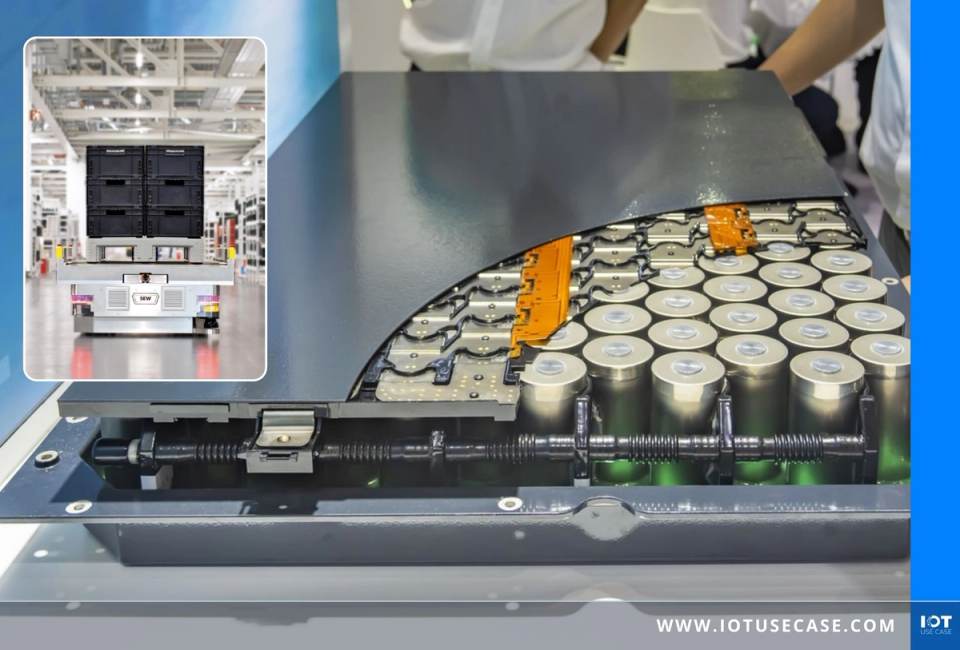
For material transport under cleanroom conditions, SEW-Eurodrive uses AGVs developed specifically for battery production with a stainless-steel body. They are designed for ISO 6 cleanroom applications and enable controlled transfer in and out between the white and grey areas of the production floor. The vehicles are based on the modular MOVI-C automation system and the MAXOLUTION system solutions, which allow material handling and transport to be adapted to the respective requirements of cell manufacturing.
SEW-Eurodrive's mobile assistance systems connect different production areas and transfer loads of over 1,000 kilograms between vehicles with the required precision. At one of Europe's large battery plants, 42 automated guided vehicles of various designs are in operation in the first expansion stage; the longest route covered is 345 metres and includes an elevator ride.
The fleet is coordinated by the Intralogistics Management Platform from SYNAOS. In a joint solution with machine builder Tronrud Engineering, it acts as the central control system: it orchestrates intralogistics in the production environment and directs the mobile robots via the standardised, vendor-agnostic VDA 5050 interface. This interface makes it possible to run vehicles of different designs in a single system – a prerequisite for keeping manufacturing flexible and adapting it to changing requirements.
The result: automated, cleanroom-compatible material flow in scalable operation
With the combination of cleanroom-compatible AGVs from SEW-Eurodrive and the central control system from SYNAOS, material transport in battery cell manufacturing runs automatically. The vehicles move heavy loads within the cleanroom requirements and reduce manual material flow in an environment where every particle introduced and every vibration is critical.
In the first expansion stage, 42 automated guided vehicles of various designs work together in live operation and also cover demanding transport routes of up to 345 metres, including level changes by elevator. Control via the vendor-agnostic VDA 5050 interface brings this heterogeneous fleet together in a single system. This keeps manufacturing adaptable to changing battery configurations and allows it to be transferred to further expansion stages and applications.
For the plant operator, this creates a material flow that meets the high demands of cleanroom manufacturing while also growing with them. The interplay of specialised hardware and adaptive software forms the basis for operating intralogistics scalably as complexity increases and across further project phases.