
Water is one of our most valuable resources – and not just since global warming. With IoT solutions, Deutsche Telekom supports utilities worldwide in reducing water losses and making supply more efficient and sustainable.
IoT against water losses – why there is a need for action
In Germany, the public drinking water supply is mainly in the hands of municipalities. With a coverage of over 99%, almost every building in Germany is connected to the public drinking water network. The responsibility for seamless supply is shared by more than 6,000 providers The drinking water pipeline system in Germany spans over 540,000 kilometers—enough to circle the Earth more than 13.5 times. Every year, around 4.7 billion cubic meters of water flow through these pipes.
Overall, this extensive pipeline network forms the basis of the drinking water supply, which ensures a nationwide and high-quality supply of the population. Since the drinking water pipes are mostly laid underground to protect them from external influences, faults such as leaks in the pipes are often not immediately recognizable. A large part of the pipeline network was laid between 1960 and 1980. Many of these cables are now reaching their standard technical service life and are nearing their expected “end of life”. Thus early detection of leaks is becoming increasingly critical for water providers.
Aging infrastructure makes water loss a costly challenge for utilities. Beyond financial impact—such as increased operational costs—and environmental consequences like water waste, it can also cause structural damage to roads and buildings. Minimizing loss and maintaining supply reliability are top priorities for providers.
Another pressing issue: skilled labor shortages. Mechanical water meters are prone to failure and must, according to German metering laws (MessEG), be checked and replaced at least every six years —a resource-intensive task with high personnel and process costs.
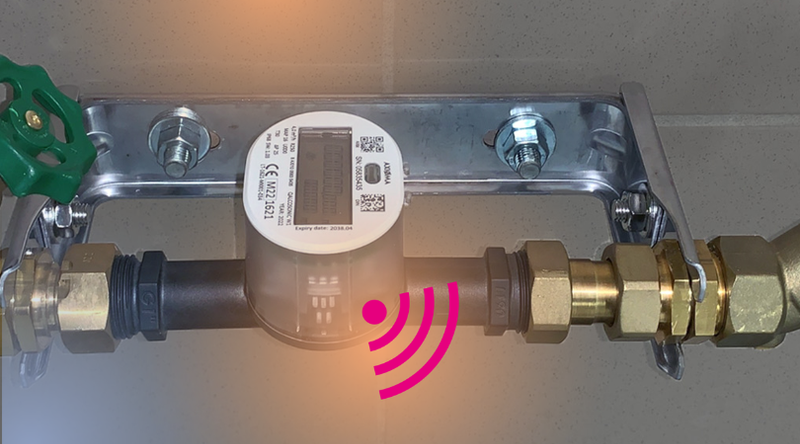
Ultrasonic meter + NB-IoT = smart solution
„With our high-end ultrasonic water meters and Deutsche Telekom’s NB-IoT network, we offer our customers a holistic solution that not only absorbs the effects of the shortage of skilled workers in the industry but also enables a more sustainable use of water as a resource."
– Jan Bangert, Deputy Managing Director at Heitland
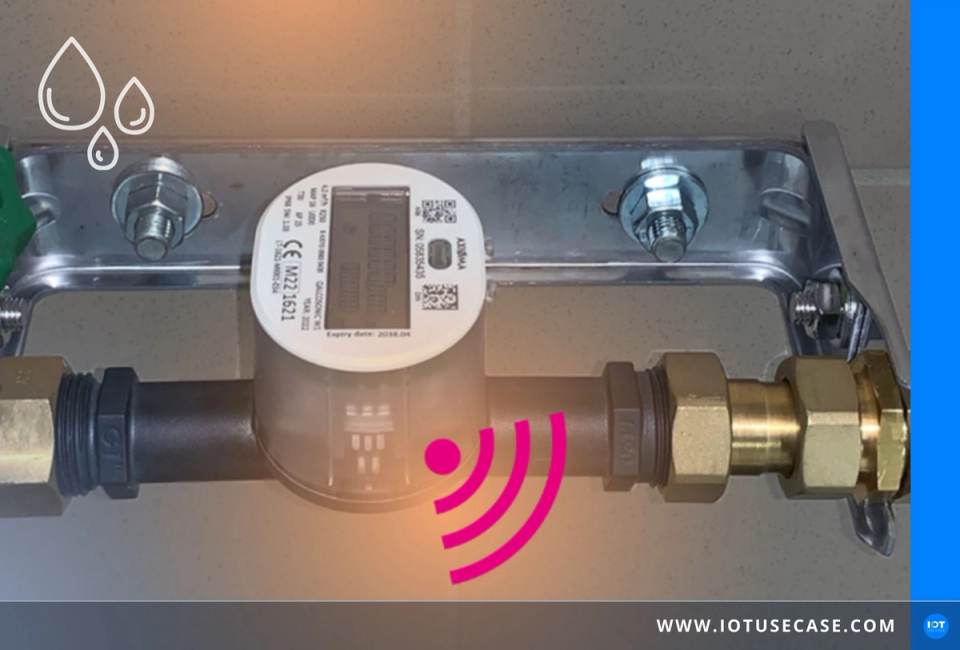
Advantage for the providers: after installing the ultrasonic water meter from Heitland, it is immediately connected to Telekom’s existing nationwide NB-IoT network. Providers can begin operation immediately and count on Telekom’s secure, reliable connectivity—independent of the homeowner’s Wi-Fi or another partially public network that is not available everywhere (e.g. LoRa or Mioty). Telekom’s service and accessibility also impressed Heitland, who want to pass this level of service on to their customers.
German-made solution, global impact
The Solingen-based company Ernst Heitland specialises in the manufacture of consumption meters for water, gas and heat. Their customers include water supply companies, cities and municipalities from Germany as well as from Austria, Switzerland and several other European countries.
Even though the German market and its regulations are unique in terms of calibration cycles and installation situation, the solution addresses a global problem. Although the framework conditions may be different, the combination of a reliable ultrasonic water meter with an energy-optimized e-SIM and NB-IoT technology is a global solution. Especially in southern countries, the issue of water loss is a critical issue.
Water tank stress test – Telekom impresses
Heitland also focuses on quality when it comes to SIMs and uses a SIM that is actually used in the automotive sector, thus exceeding the industry standard. Jan Bangert, Deputy Managing Director at Heitland, speaks of an aha experience when using the test SIM card for the first time. For example, it is particularly difficult to receive data from meters that are installed in shafts or even in flooded shafts, and you often don’t get a signal from 15 cm of water above the meter. The colleagues wanted to do the stress test and threw a meter with the built-in Telekom SIM into a 2-meter-deep water tank under the production hall and were amazed when the meter transmitted data every day. It was immediately clear to Heitland: this is the technology we want to use.
„If we get a signal from a 2-meter-deep water tank with Deutsche Telekom, then it also works in the deepest Bavarian forest and certainly also in (almost) all pits, as well as everywhere else in the world!"
– Dipl.-Ing. Mike G. Hiatt, Head of Marketing and Sales at Heitland
More transparency, less effort
With conventional mechanical meters, utilities have to read their own meters on site or ask their consumers to read and submit meter readings by postcard. This is often inaccurate, error-prone, delayed and only possible once a year due to the great effort. Until now, there has been a lack of transparency to detect water losses at an early stage. With the specially developed NB-IoT ultrasonic water meter, which is connected via the Internet of Things (IoT), Heitland solves the problem. The measurement accuracy of the smart meter is more accurate than with conventional meters, even over many years of use, and daily consumption can also be viewed. When it comes to connectivity, Heitland relies on Deutsche Telekom’s experience. The roaming offer was particularly convincing here. One framework agreement, one contact person, one platform for managing the SIM cards, regardless of where and to which provider the meter is delivered. All of this increases the accessibility of the meter even in remote areas and makes it easy to expand abroad. Deutsche Telekom’s pre-payment offer makes billing with providers even easier, which is just as important given the number of metering points.
Sustainability through extended lifespan
In Germany, the calibration of water meters is mandatory and regulated by law. For example, after 6 years, a random inspection of the installed meters can be carried out. In the case of mechanical meters, which are still frequently used at present, the probability that the test will not be passed is so high that providers replace all meters as a precaution. This means not only costs for the new measuring device and for the replacement, but above all massive process and logistics costs: Customers have to be informed, appointments have to be made and the installers enter private rooms.
The innovative Heitland ultrasonic water meter with NB-IoT connectivity from Deutsche Telekom, on the other hand, is so reliable that it can be used for at least 12 years. It is a premium device made of robust composite material but will also be available in a brass version in the future. With Deutsche Telekom’s particularly energy-saving and durable e-SIM, the devices remain reliably connected. The manufacturer even assumes that the meter can be used for up to 16 years. The end of the service life is determined by the battery. Produced exclusively for Heitland by Axioma in fully automated Lithuanian factories, one new meter rolls off the line every 15 seconds.
Sustainability that pays off
- •It is a simple calculation example, says Mike G. Hiatt, Head of Marketing and Sales at Heitland: “A mechanical meter costs only about 1/3 to 1/4 of an ultrasonic meter, but after 6 years I need a new one. We quickly reach 50 % costs just for the material. A meter change after 6 years then also costs. This alone brings me to similar costs compared to the purchase price for an ultrasonic meter with NB-IoT. Additional revenue due to better and fairer measured values (between 3 and 7 %) and accurate billing as well as reduced process costs, as the reading is fully automatic, has not yet been considered. In its entirety, a mechanical meter costs far more than an ultrasonic meter over a service life of 12 years. Not to mention how convenient it is to read, exact cut-off date, with the ultrasonic meter now.”
Smart solution compensates for shortage of skilled workers
Finding suitable personnel is probably difficult in any industry. This is also the case with water providers. The physical replacement of the water meters is time-consuming and requires a lot of personnel. But there is also a high demand for personnel in the back office, when obtaining readings, maintenance and possibly processing complaints. Here, too, the innovative technology can help. Since the ultrasonic meter is not only more durable and transmits its data independently, but also has an internal memory, historical data can also be read out and used for analysis in the event of a complaint. The end consumer can also view this data directly via the associated smartphone app and set alarms in the event of malfunction (frost, leaks in the house installation and much more).
Source: Telekom Deutschland