
Cummins is a global provider of power and drive systems, headquartered in Columbus, Indiana, with around 70,000 employees. The company supplies diesel and electrified powertrains to more than 100 major OEMs, including PACCAR DAF, Daimler Trucks, and the TRATON GROUP (Scania, MAN, International Trucks). As vehicles become increasingly software-defined, Cummins is re-architecting how its powertrains are developed, updated, and managed – guided by a single principle, “write once, run anywhere”: a modular software architecture that can run on a wide range of connectivity devices across its entire OEM and fleet network.
The project is delivered together with IoT technology partner Portainer.io. Cummins develops the container-based software platform and runs it on embedded Linux devices mounted directly on the engine. Portainer.io provides the capability to orchestrate and update OCI containers on these devices remotely, using a server-and-agent architecture. The result is not a one-off solution for a single vehicle, but a scalable foundation for rolling out software consistently across the entire connected fleet.
The challenge: Fragmented telematics software and no remote management in the field
Over the years, the telematics stack at Cummins had grown into 35 different versions of near-identical software, each tied to a specific aftermarket provider’s hardware. When Cummins launched the initiative in 2012, there were no suitable device options for connectivity and telematics functions, so the software had to be written separately for each partner environment. With two partners at first and 35 later on, that meant maintaining the same edge and connectivity functionality in 35 variants. Every new feature and every fix required its own integration and testing across dozens of suppliers – driving up cost, time, and risk.
When Cummins began developing its new generation of connected powertrains in 2019, the goal was to unify this fragmented landscape. The stack needed to be consolidated across OEMs and devices, over-the-air updates had to be possible without physical intervention, and strict security, safety, and performance requirements had to be met at the same time.
One central technical gap stood in the way: once the embedded Linux devices were built into the vehicles, there was no way to orchestrate or update containers on them remotely. Touching a device in the field again is like a product recall — expensive and time-consuming. Without reliable remote management, the “write once, run anywhere” ambition could not be realized.
„Once a device is out in the field, physically touching it again is like a product recall – it’s expensive and time-consuming. So the challenge was, how do you make sure you never need to touch a machine again?"
– Neil Cresswell, CEO and Co-Founder
The solution: Modular OCI containers with remote orchestration via Portainer
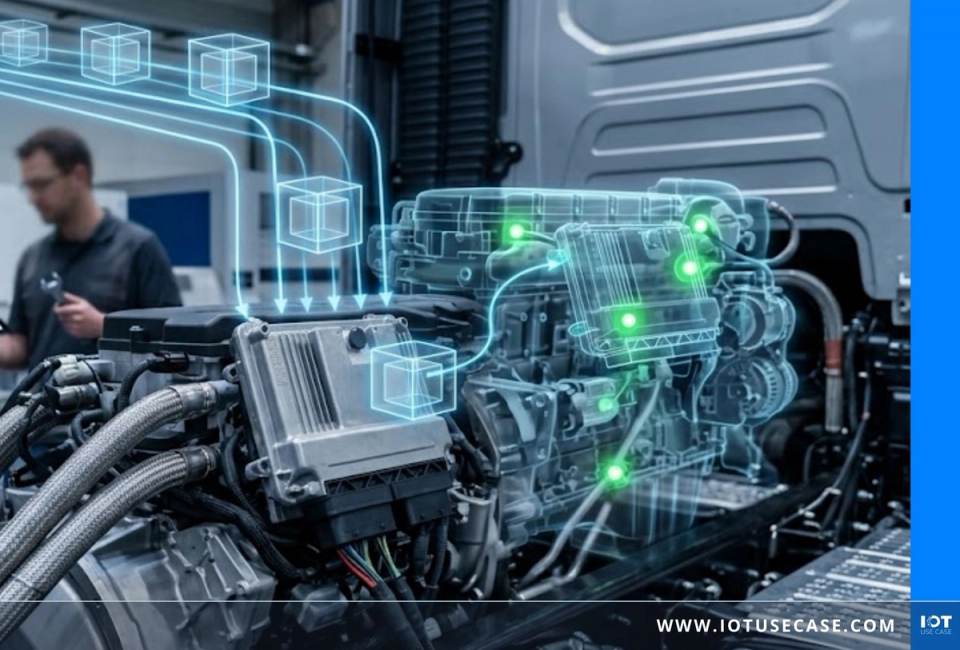
Cummins used OCI containers (Open Container Initiative) to separate the application layer from the operating system layer, moving away from its proprietary, Java-based legacy platform. Instead of 35 software variants, Cummins now provides its partners with a single OCI container that they deploy to their connectivity device. The embedded Linux devices are mounted directly on the engine and communicate with the engine control unit.
For the gap that mattered most to Cummins – remote orchestration of the containers – the company chose Portainer Business Edition. Portainer.io uses a server-and-agent architecture: the server handles management, while the agent runs on the devices in the field and receives instructions. For this use case, Portainer.io redesigned the agent to cope with limited bandwidth, high latency, and recurring network dropouts – conditions that arise when vehicles travel at high speed and repeatedly lose cellular coverage. Through Portainer, Cummins delivers secure, atomic, and fail-safe updates to every connected device.
Beyond the technology, the provider’s way of working was decisive: while other vendors initially offered only an open-source version to test, Portainer.io worked closely with the Cummins team on the solution from the very beginning.
„Neil and his team were engaged from the start. They acted as if they were part of our team, working through the solution with us even before we had an official agreement in place."
– Martin Brown, Software Architect
Cummins also uses container orchestration beyond the application software itself. The team led by software architect Martin Brown developed a way to use the same orchestrator to update the edge device’s Linux operating system as well as the engine control unit software. The engine control unit has no connectivity of its own and receives its updates via the embedded Linux device. Cummins published this approach on IP.com under the title “Updating Embedded Linux OS Using OCI Container Technology.”
Delivered through Portainer Business, the solution provides in particular:
- remote container management and orchestration at IoT scale
- agents on the field devices optimized for low bandwidth and high latency
- centralized fleet visibility with health monitoring and deployment tracking
- role-based access control and security for production operations
The result: From 35 software versions to one production-ready architecture
By containerizing its edge software and standardizing deployment through Portainer, Cummins reduced its software variants from 35 to one. The new system went into production on time — a first for the telematics platform at Cummins, whose proprietary predecessor had spent two years in production without delivering all planned features at launch. Simplified development and maintenance bring costs down, because new features no longer have to be integrated and tested across dozens of supplier environments. At the same time, OEM partners no longer need to coordinate with many different suppliers and software packages.
„It’s far more convincing to show partners what we have running in production rather than just presenting a PowerPoint concept and promising it will work."
– Carlton Bale, Director of Software
What began as a prototype now serves as a reference architecture for software-defined vehicles: the same container-based approach is being adopted across the industry as a standard way to deploy software on diverse hardware platforms. Cummins contributes its experience, interfaces, and APIs as open source to the Eclipse Software Defined Vehicle Working Group and to COVESA (the Connected Vehicle Alliance), and takes part in projects such as uProtocol and S-CORE.
For Portainer.io, the collaboration had an effect well beyond this single case. To support deployments at the scale Cummins required, Portainer.io redesigned core parts of its architecture — particularly for concurrency and reliability across hundreds of thousands of devices communicating at the same time. These improvements benefit all Portainer customers.
„Working with Cummins pushed us to redesign core parts of Portainer to handle concurrency and reliability at IoT scale — hundreds of thousands of devices, all communicating securely and concurrently."
– Neil Cresswell, CEO and Co-Founder
This use case shows how container technology can be carried from the data center to the edge inside the vehicle — as a shared foundation on which applications and services are run and updated consistently across OEMs and fleets.