In many established manufacturing environments, integrating new machines into existing lines takes considerable effort. Line controllers (PLCs) are usually programmed rigidly, and data from individual machines and subsystems exists in different semantics. The Asset Administration Shell (AAS) addresses this challenge as a standardized data interface – within a plant and across company boundaries.
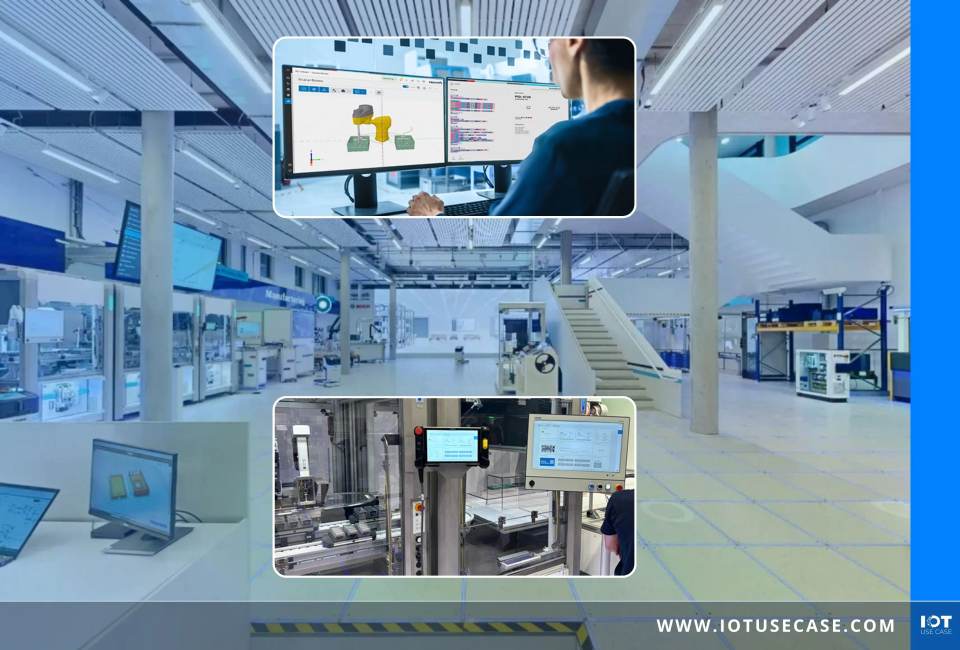
At the model factory run by Bosch Rexroth in Ulm, Germany, it becomes clear how this standard translates into concrete production flexibility. Bosch Rexroth provides the automation and orchestration foundation with ctrlX Automation and the Factory Orchestration Platform (FOP), and operates the model factory as a permanently accessible application environment. As a software service provider, XITASO supports the creation of the AAS and offers, among other things, a function block for brownfield machines. The following use cases show how the AAS is applied in different configurations.
The challenge: integrating machines and modules into brownfield lines and making data available end to end
Integrating new machines into existing lines is time-consuming in practice. Line PLCs are programmed once and become hard to trace over time; when a machine is replaced or added, integration work often drags on for months. Unlike in a structured automotive assembly plant, where data is transferred along the value stream as a matter of course, end-to-end connectivity in mechanical manufacturing is in many cases still lacking.
This is compounded by the fact that use cases and system configurations change continuously. Data has to be carried along consistently throughout – across machines, modules and subsystems that provide their information in different semantics. If the same fields, such as an article description, are populated differently, incompatibilities arise, and data first has to be normalized before it can be used across company boundaries.
For manufacturing, the resulting lack of a data foundation is particularly relevant with regard to overall equipment effectiveness (OEE). Without continuously available condition and process data, it is difficult to make losses at individual machines transparent, and maintenance or reconfiguration decisions rely more on experience than on robust data. What was needed, therefore, was a way to connect machines and modules in a standardized manner, make lines more flexible to (re)configure, and create the data transparency required for this.
The solution: the Asset Administration Shell as a standardized data interface and basis for line orchestration
The AAS is a standardized way of preparing and providing an asset's data. It contains subsystems (submodels) defined by the standardization organization – for example the Nameplate submodel (digital nameplate) or the Skills and Capabilities submodel. The goal is to make data available in such a way that other companies and users can read and populate it in the same form.
In the model factory, every machine and every module receives an AAS – down to the floor and the lighting. On this basis, Bosch Rexroth models the line via the Factory Orchestration Platform using business logic, instead of hard-coding sequences into the line PLC. Once all machines or machine modules are available as an AAS, processes can be designed flexibly and the line can be reconfigured between AGV/AMR systems and stationary machines.
XITASO supports the standardized creation of the AAS, which in practice is the first hurdle for many users. For brownfield machines, XITASO offers a PLC function block that generates a standard AAS: the signals are connected to a gateway on which the function block runs, so that a standard AAS can be provided without extensive preparatory work. If this is not sufficient, it can be extended with additional submodels.
In the model factory, the AAS, OPC UA and MQTT were used in parallel and selected depending on the use case: for individual motion commands, MQTT was, for example, well suited; sensor signals, such as from a level sensor, can be transmitted well via OPC UA. The AAS is particularly well suited to standardized data exchange across company boundaries, for example to speed up the data side of the commissioning process when registering new machines.
Use Case A: battery assembly and disassembly at the Ulm model factory
For the battery assembly and disassembly line, Bosch Rexroth and XITASO created an AAS for each module in order to control the modules flexibly. The Skills and Capabilities submodel maps the capabilities of the individual machine modules. This enables not only data exchange but also the flexible switch between mobile and stationary stations.
Use Case B: flexibly configurable lines in series-production plants
Beyond the model factory, Bosch Rexroth is rolling out the Factory Orchestration Platform internally. In Bosch plants where high volumes (such as ABS systems in the millions) have so far been produced on rigid lines, flexibly configurable lines based on the AAS are emerging to respond to increased flexibility requirements. The platform is also in use at a further Automotive Tier 1 user; machine builders that supply half or entire lines are likewise asking for reconfigurable solutions.
The result: standardized connectivity, flexible configuration and greater data transparency
With the AAS, the model factory has a standardized data interface in place through which machines and modules are connected uniformly. On this basis, the line can be modeled via Bosch Rexroth's Factory Orchestration Platform using business logic and reconfigured as needed. XITASO contributes to this by creating the AAS in a standardized way and integrating brownfield machines via the function block described above.
The standardized approach reduces dependence on individual specialist knowledge: because interfaces and data models are documented and protocols are used as intended, the connectivity landscape is easier to trace than with a rigidly programmed line PLC. For data transparency, the following applies: standardized readout makes it possible to reveal losses at a suspected bottleneck machine – in the simplest case via parts in/parts out per shift – so that assumptions are backed up with real data.
In the model factory, production only takes place during demonstrations; OEE there is therefore not improved but made transparent. The benefit initially shows up in the standardized connectivity, the flexible configuration and the data transparency created.
The recommended approach from these projects is to start small and equip the suspected bottleneck machine with an AAS first, since this is where the fastest return on investment and an early success that can be shown to management can be expected. The first step focuses on data transparency, the second on orchestrating the line. Introducing the AAS should not be equated with introducing an MES or ERP system, and it can be rolled out gradually.
Outlook: AI in OT and distributed knowledge
As next development steps, Bosch Rexroth and XITASO see the use of AI based on IoT data along the machine lifecycle – for example the (partially) automated creation of the AAS by AI agents, the use of AI in engineering, and the analysis of time series during operation. Looking ahead, machines could increasingly be engineered, configured and operated with AI support.
At the same time, a trend toward distributed knowledge is expected: individual PLC specialists are being replaced by teams that work on a project using different technologies. Documentation and standardization remain central to this, as does scaling across plants and sites. Beyond technology and target visions, what remains decisive is bringing the people involved along and agreeing on a shared vision.