

Condition-based filter monitoring avoids unnecessary costs and downtime
Goal of the project
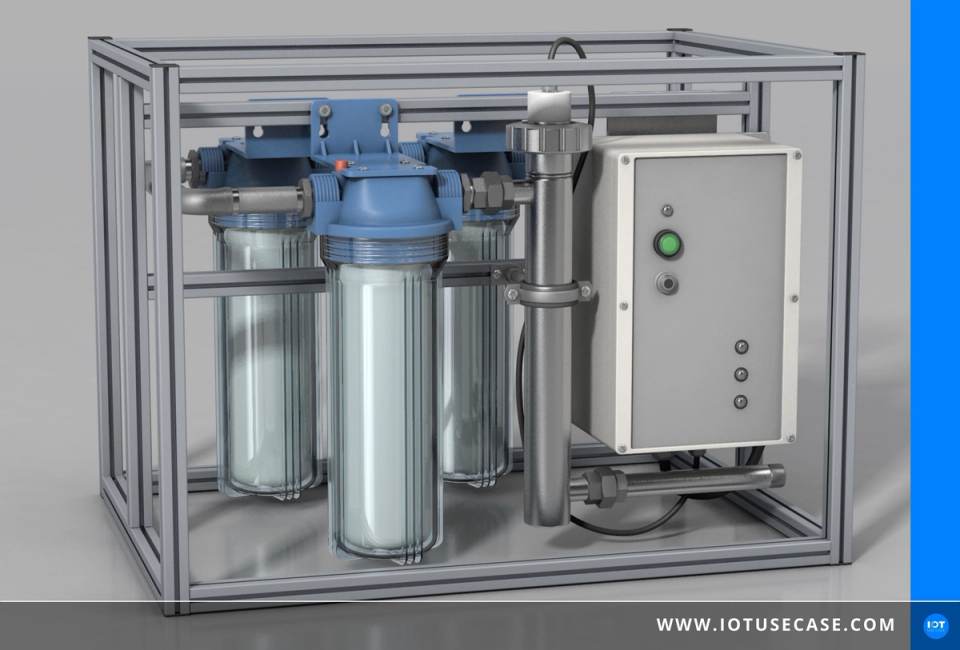
Filters have the important task of filtering out contaminants in different media and thereby protecting the plant. They are used in all producing branches of industry, such as the pharmaceutical, chemical, automotive, automotive supplier, electronics and food industries. They are applied in various areas within a production process and, as wear parts, must be replaced regularly. If this does not happen, components will become faulty or, in the worst case, machine downtimes will occur – a nightmare for every manufacturer. However, maintenance always means machine downtime, too, and should be optimally scheduled.
moneo LifetimeEstimator, an AI-based solution from ifm, helps you monitor the condition of all filters to ensure their optimal usage and replacement. This tool records the actual contamination level of a filter based on corresponding sensor data. ifm’s filter monitoring continuously monitors the filter condition, calculates its remaining service life, and alerts you well in advance with a defined lead time when a replacement is needed.
This means that filter replacements can be planned at an early stage without having to rely on regular maintenance intervals. As a result, resources are used efficiently, downtimes are avoided and money is saved. In addition, maintenance can be optimally planned, ensuring a seamless process with maximum machine uptime.
Business case – air filters


On average, customers achieve:

Business case – water filters

On average, customers achieve:

Business case – oil filters
On average, customers achieve:
Use filters optimally and consider real wear
Super simple – with the moneo software solution. The software monitors the filter and records the resulting data directly in the production process. Based on the recorded sensor values, the running time of a filter can be adjusted according to the degree of contamination, ensuring optimum filter utilisation. Permanent filter monitoring results in the optimisation of the entire process by avoiding unplanned downtimes – changing from time-based to condition-based maintenance. The responsible personnel receives the warnings and alerts directly via email or a ticket system, so that they can react quickly to changes.
Contamination and filter defects are detected promptly and expensive consequential costs for process and machine are therefore prevented. Timely detection of errors and alerts for filter replacements help maintain machine uptime and enhance process quality. With LifetimeEstimator, you can create the corresponding maintenance order with a custom lead time, ensuring the filter replacement is incorporated into maintenance planning. The environmental impact and the operating costs are sustainably reduced by the new maintenance strategy. The personnel expenditure for condition evaluation and filter replacement is reduced to a minimum. moneo is also easy to use and can be adapted to customer-specific requirements without any difficulty. This ensures that filters are always changed at the right time – neither too early nor too late – so that any associated costs can be avoided.
Value proposition
- •Machine availability
- •Process quality
Condition-based instead of time-based maintenance
Filter monitoring plays an essential role in the smooth operation of production plants. Filters are an often overlooked component in production or building systems. They are usually replaced after a specific time interval, without considering the actual soiling of the filter. Machine downtime due to defective or clogged filters and unplanned production standstills due to maintenance work are the norm. This results in additional costs due to replacing the filter too early or too late.
To avoid additional costs, monitoring and visualisation of the filter taking the actual condition into account should be implemented. The aim is to replace the filter as needed to enable optimal use. moneo offers an ideal solution for optimal filter monitoring. The tool makes it possible to change from time-based to condition-based maintenance.
moneo simulation video
Cost-optimised maintenance of various filter systems
We distinguish between three different filter systems, because each filter system is subject to different requirements and specifications.
- Air filters
- Water filters
- Oil filters
Operating principle of
Air filters
Air quality in the workplace and at the respective machines is crucial. For this reason, air filters are used in extraction systems in production facilities. The resulting vapours should be extracted from the machines to prevent quality defects caused by dust and vapours. Air in the factory must also be constantly cleaned to prevent damaging employees’ health due to contaminated air. Legal regulations on air quality (in Germany: Technical Instructions on Air Quality Control) must also be adhered to. To record the air quality or soiling of the filters, pressure sensors are installed before and after the filter to ensure continuous monitoring. The corresponding tool evaluates the data and indicates necessary filter maintenance at an early stage.
Water filters
Microfilters are installed in cooling circuits to ensure that systems with heat exchangers run smoothly. These water filters take on the important task of filtering out impurities in the cooling water, thereby protecting the heat exchangers in the connected machines. With water filters, the cooling capacity of a machine is also important. If the filters are dirty, the machine or parts of the machine are no longer cooled properly, resulting in defects in the machine and the manufactured component.
Oil filters
In addition to air filters and water filters, condition monitoring of oil filters is of particular importance. Oil filters are an important component in hydraulic and lubrication units. Undetected soiling leads to damage with possibly high follow-up costs. If a filter becomes clogged sooner than expected, there is likely to be an issue with the lubrication of the bearings or gears, and failure of these components is inevitable. In hydraulics, the oil must have a certain level of purity. This can only be achieved using filters installed in the return line. Appropriate filter monitoring is therefore absolutely necessary to ensure the process and operation of the plant.
With ideal use of filter monitoring, numerous factors are taken into account to prevent unplanned failures, reduce costs and use resources optimally. At the same time, machine availability is increased and employees’ health is protected. Artificial intelligence can help to monitor these processes.
AI-assisted plant monitoring: How moneo LifetimeEstimator maximises machine availability
Everyone is talking about Artificial Intelligence (AI), but how can it really be used? AI can be applied in many different areas, including production. For example, moneo LifetimeEstimator is a powerful AI tool that can accurately monitor and predict the remaining service life of machinery and equipment, in our case filters, by analysing historical data and selecting the best calculation model.
This leads to an improved maintenance strategy and more efficient use of resources.
Automated maintenance interfaces
The comprehensive solution from ifm sensors in conjunction with the moneo software opens up a wide range of options and offers numerous interfaces. Data processed in moneo can be exported using different protocols.
It is possible to use data via MQTT or OPC UA in a third-party system or to transmit data directly to AWS, Azure or SAP via a specific connector.
By integrating ifm’s own SFI (Shop Floor Integration) interface, a direct connection to SAP PM is possible. The solution serves as an interface between production and business levels and offers the possibility of automatically triggering further follow-up processes when limits are exceeded. The maintenance engineer receives an email notification when the specified threshold values are exceeded and warnings and alerts are sent out. This makes it possible for them to plan a suitable replacement or cleaning at an early stage and to order spare parts. Depending on customer requirements, alarms can also trigger ordering directly through SAP.
The filter monitoring is possible in conjunction with the moneo cloud. ifm provides the necessary interfaces to store your data in the cloud and, if necessary, use it for further analysis. The moneo LifetimeEstimator can be used directly in the moneo cloud.
System structure
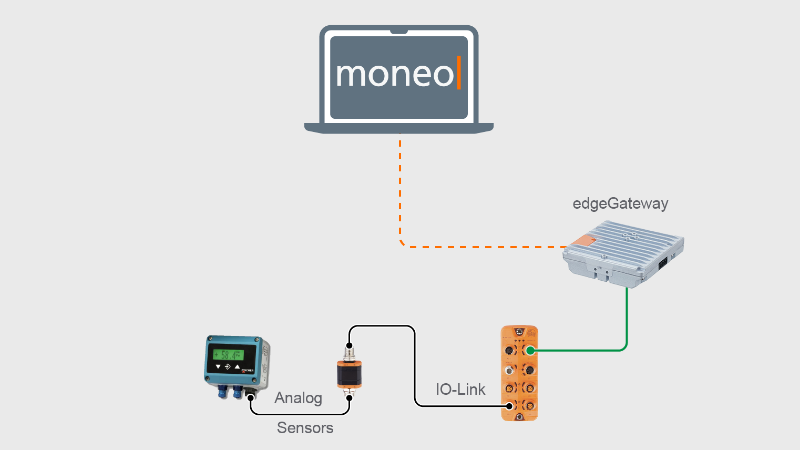
Air filter
- •IO-Link master (VLAN)
- •IO-Link pressure sensor (before filter)
- •IO-Link pressure sensor (after filter)
- •IO-Link pressure difference sensor
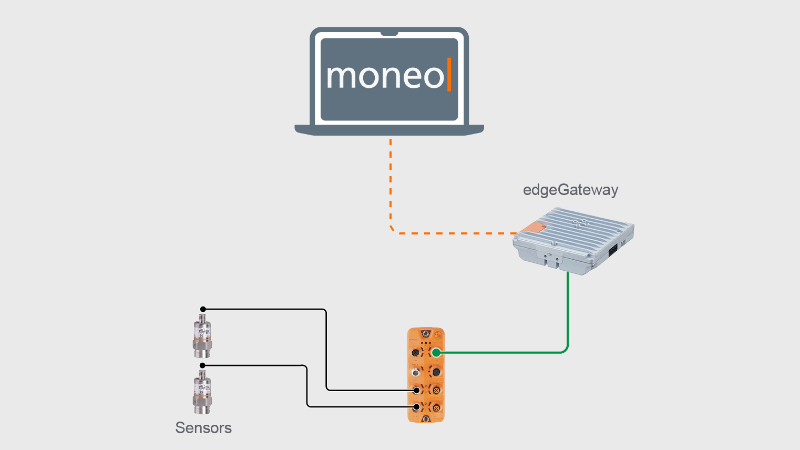
Wasserfilter
- •IO-Link Master (VLAN)
- •IO-LInk Drucksensoren
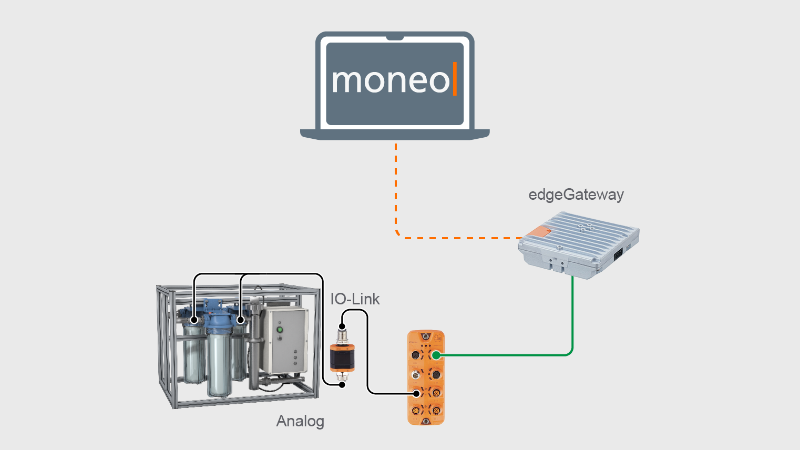
Ölfilter
- •IO-Link Master (VLAN)
- •Drucksensoren
- •IO-Link Konverter
Implementierung von Filterüberwachungen zur Kosteneinsparung
Für die Filterüberwachung wird die Softwarelösung moneo und der moneo LifetimeEstimator als Teil des Industrial AI Assistant Pakets zentral auf einem Server installiert. Ein IO-Link Master ist über ein intern gesichertes Netzwerk (VLAN) mit dem Server verbunden. Am Wasser- oder Ölfilter werden jeweils zwei Sensoren installiert. Dabei nimmt ein Sensor den Druck vor dem Filter und der zweite Sensor den Druck nach dem Filter auf. Aus diesen beiden Druckwerten kann ein Druckdifferenz ermittelt werden, der den Filterzustand beschreibt.
Beim Luftfilter wird ein Differenzdrucksensor angeschlossen. Dafür ist eine möglichst genaue Druckmessung notwendig. Alle Drucksensoren verfügen über eine IO-Link Schnittstelle, die die Daten an einen IO-Link Master übergeben. Beim Differenzdrucksensor an Luftfiltern wird das Signal analog auf IO-Link umgesetzt. Der IO-Link Master übermittelt die Sensorwerte anschließend an moneo.
moneo übernimmt die Weiterverarbeitung der Daten. Dazu gehören die Berechnung der Druckdifferenz, das Speichern der Historiendaten, die Visualisierung der Daten und die Überwachung der Grenzwerte. Zur Überwachung der Filter werden die jeweiligen Grenzwerte für die Warn- und Alarmschwelle definiert. Grenzwertverletzungen werden über die SFI-Schnittstelle an das SAP-System übermittelt.
Um die notwendigen Instandhaltungsmaßnahmen mit ausreichend Vorlaufzeit planen zu können, kommt der moneo LifetimeEstimator zum Einsatz. Dazu werden im ersten Schritt zwei Wechselintervalle des Filters in moneo aufgezeichnet. Anschließend wird im zweiten Schritt der moneo LifetimeEstimator mit den aufgezeichneten Zyklen angelernt und eingerichtet. Der oben erwähnte Grenzwert aus dem Datenblatt dient hierbei als Endpunkt eines Zyklus.
Der Zeitpunkt für die Meldung zur anstehenden Instandhaltungsmaßnahme wird auf 7 Tage vor Erreichen des Grenzwerts gesetzt, um den nötigen Filterwechsel bei der wöchentlichen Personalplanung berücksichtigen zu können. Aufgrund dieser Datenbasis zeigt sich, ob der Filter nach den Messergebnissen zugesetzt ist oder die Laufzeit des Filters sogar deutlich gesteigert werden kann. Innerhalb weniger Wochen ist es bereits möglich, erste Erfolge festzustellen. Die Sensoren zeichnen die tatsächliche Nutzung und damit Verschmutzung der jeweiligen Filter auf.
- •Stillstandszeiten werden vermieden und Wartungszeiträume für den Filteraustausch können optimal geplant werden.