
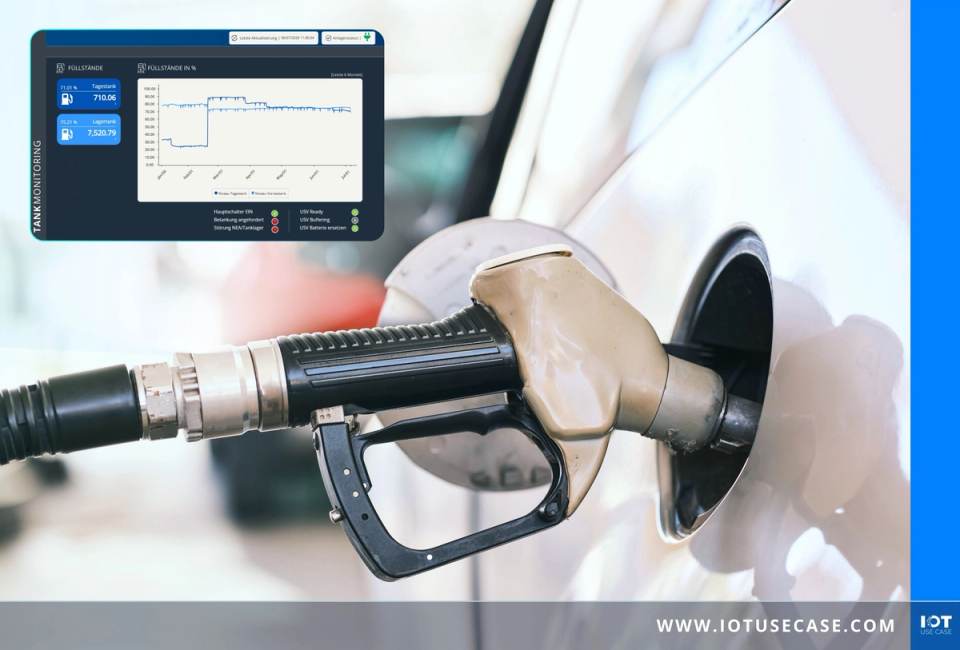





Public institutions that form part of the critical infrastructure keep fuel reserves at many of their sites so that they remain able to act even when the external supply is disrupted – by a power outage lasting several days, for example. For those reserves to be reliably available when it matters, their fill levels have to be known at all times and plannable across every site.
The German state of Hesse has set up a digitalisation project to achieve this: at 48 sites at present, the fill levels of strategically positioned fuel tanks are recorded centrally and automatically instead of being read off one by one on site. The result is a continuous, cross-site picture of the reserves available – the basis for dependable decisions in day-to-day operations as much as in a crisis.
The technical concept and the IIoT platform come from VISUALYS GmbH, which, as a provider of industrial IoT solutions, developed and coordinated the entire system architecture. The hardware installation on site – from building the control cabinets and mounting the sensors through to commissioning – was handled by Werner Elektrotechnik GmbH from Eltville am Rhein. The IIoT gateways for secured data transmission come from Wachendorff Prozesstechnik. Both companies belong to the Wachendorff Group, from which VISUALYS emerged in 2019 as a corporate start-up – so platform and hardware come from a single group of companies and are matched to one another.

The challenge: distributed fuel reserves without continuous fill-level data
Until now, the fill levels of the tanks could only be recorded by means of manual inspection rounds. With almost 50 sites spread across Hesse, that approach ties up staff and time and, by its very nature, delivers no more than isolated snapshots. A continuous data set that is comparable across sites simply cannot be obtained this way – no matter how carefully the checks are carried out on site.
Several requirements followed from this, for day-to-day operations as much as for a crisis:
- A reliable statement of the reserves actually available at each site
- Early notification before a tank falls below a critical alert threshold
- Uniform, plannable processes instead of assorted lists and manual checks
- Granular access rights, given that these are critical infrastructure sites
- Transferability to further properties and equipment
At its core, this was less about fixing one acute problem than about moving from scattered individual records to a uniform, plannable monitoring system – as the basis for the sites' operational readiness, including during longer-lasting disruptions.
The solution: ultrasonic fill-level measurement via MQTT to a central IIoT platform
The contribution from VISUALYS lies above all in bringing existing installations from different manufacturers that have no common interfaces together on one shared, secured platform, and in coordinating the partners involved throughout the implementation. The basis for this is a modular IIoT architecture that unites data acquisition, transmission, processing and visualisation and that transfers the measured values to a central platform over secured channels.
Fill-level measurement and data acquisition
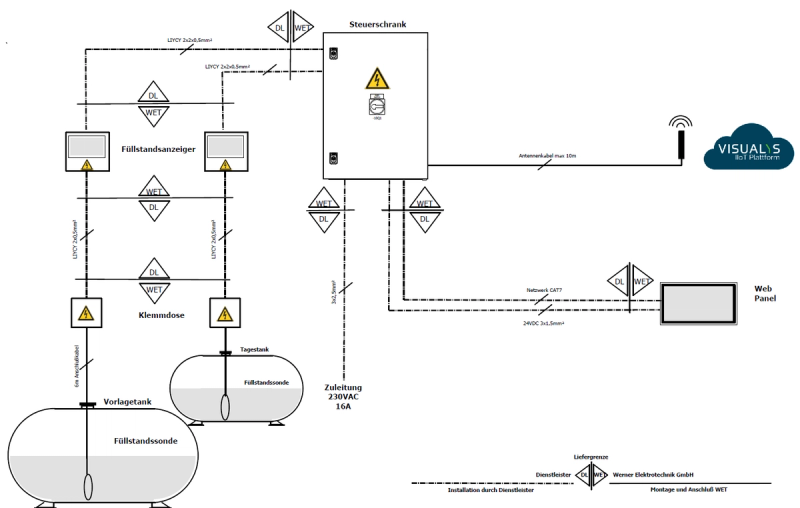
At each tank, an ultrasonic sensor with a 4…20 mA output records the fill height. The sensor is connected to the analogue input of a router, which polls the reading continuously. If the fill level changes by a defined amount, the router sends the new value to the VISUALYS platform via MQTT. In addition, the value is transmitted at least once a day even when it has not changed, in order to verify the communication link.
Connectivity and remote maintenance
Depending on the site, the router is either integrated into an existing local network or connected to the internet via a built-in LTE modem. All routers are additionally reachable via OpenVPN, so that their firmware can be checked remotely and updated where necessary – an aspect that also matters in view of the requirements of the Cyber Resilience Act (CRA).
On-site installation by Werner Elektrotechnik
Werner Elektrotechnik GmbH took care of the technical implementation at the sites:
- Drawing up the circuit diagrams and building the system-specific control cabinets
- Mounting and wiring the sensors at the tanks
- Integration into existing networks or setting up the LTE connection
- Commissioning and function tests
Platform and operation
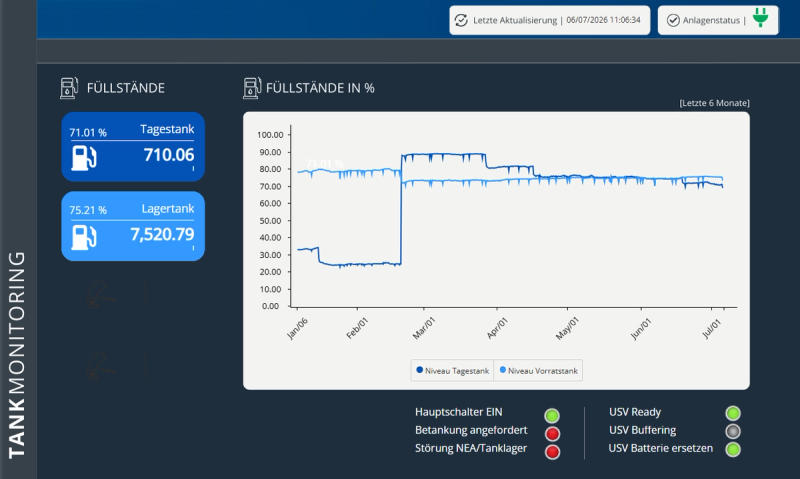
The VISUALYS platform was configured to the customer's requirements and equipped with a dashboard that derives and visualises operating states from the incoming measured values. Alarm thresholds are stored for critical fill levels; if a level drops below an alert threshold, an email notification is triggered automatically. A local display additionally shows the most important operating states on site. Beyond that, the platform transfers the data cyclically to a central data cloud, processes external control commands, presents trends and historical curves, and manages user roles and permissions. The dashboard is designed for different user groups and fits into the existing administrative processes.
Security and permissions management
Communication between the routers and the platform is encrypted without exception, access is logged and the data is stored redundantly. Role-based permissions management ensures that only authorised individuals gain access to the site data – a prerequisite that follows from the sites being classified as critical infrastructure.
The result: plannable reserves and far fewer inspection trips
With the solution implemented by VISUALYS, the German state of Hesse has the fill levels of all 48 sites in view centrally and almost in real time. The manual inspection rounds are gone: this saves around one to three hours of effort per site per week, because nobody has to drive out to check on site any more.
The automatic email alarm triggered when a level drops below an alert threshold ensures that no tank runs dry unnoticed and that a fuel supply for several days is kept in reserve. For the first time, the sites' readiness during a longer-lasting power outage is therefore something that can be reliably planned for – a statement that could not be made with certainty before the system was introduced. The added value lies less in solving one known problem than in being able to plan end to end and in assured operational capability.
For those responsible, this results in:
- a uniform data set spanning all sites instead of scattered individual lists
- plannable refills based on actual fill levels instead of fixed intervals or snapshots
- reduced staff and travel effort for the checks (around 1–3 hours per site per week)
Outlook: transferable to further infrastructures
The VISUALYS architecture is designed so that it can be transferred to further properties and other equipment – to the monitoring of emergency power generators, building services or energy management, for instance. Because sensors from different manufacturers can be connected via the gateways from Wachendorff Prozesstechnik and the installation follows the established procedure of Werner Elektrotechnik GmbH, additional sites and measured variables can be added without any fundamental rebuild.