
Transparent Project Steering at Grob-Werke
GROB-WERKE, one of the world’s leading manufacturers of systems and machine tools, joined forces with b.telligent to merge project costs, forecasts and IoT machine data into a central Microsoft Fabric platform. Project managers now receive meaningful reports within seconds, monitor disruptions in real time and control budgets, capacity and deadlines far more transparently.
Initial Situation & Challenge
GROB-WERKE faced the challenge of analyzing its increasingly complex project and machine data in a transparent, timely, and consistent way. Project costs and project progress were not available at the same time. The information could only be connected manually, which meant decisions about budgets, resources, and project priorities were often based on outdated or incomplete information—with tangible risks for schedules, costs, and profitability.
In addition, planning and forecasting processes were not seamlessly integrated into reporting. Changes to project planning had to be made outside the reporting landscape, creating media discontinuities, redundant data storage, and limited planning reliability. At the same time, the internal IoT solution for client-specific requirements generated large volumes of telemetry and fault-message data. However, internal analysis via direct API connections in Power BI was technically complex, difficult to scale, and limited in performance. It was also clear that the solution in use was scheduled to be discontinued in 2027.
To address these bottlenecks, GROB-WERKE worked with its partner b.telligent to build a central, scalable data platform based on Microsoft Fabric. The goal was to bring project cost reporting, integrated planning, and real-time data analysis together in one consistent environment. The resulting transparency across all projects was intended to sustainably improve decision-making quality throughout the company.
Solution
At GROB-WERKE, b.telligent followed a structured, multi-stage approach that closely connected strategy, organization, and technology. At the start, the business departments and IT jointly identified the key use cases, which were then translated into an overarching data strategy—including clear data governance rules. This created a shared understanding early in the project of the key metrics, processes, and quality requirements for project costs, planning, and fault messages.
Building on this foundation, a hybrid collaboration model was established: data and responsibility were organized into data domains—with decentralized proximity to the business and centralized standards.
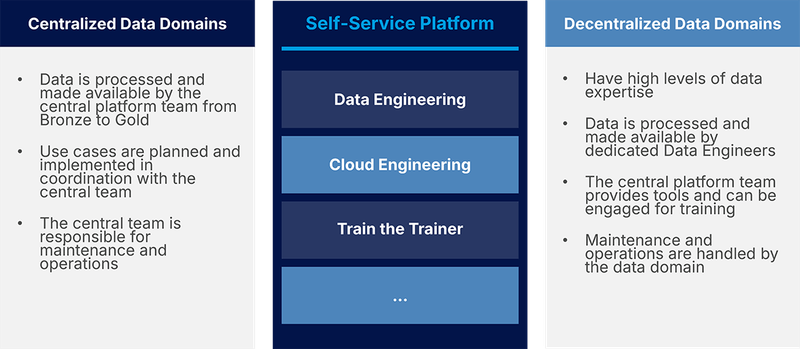
This model enables the data domains to implement their own requirements in an agile way without compromising consistency or governance. In parallel, b.telligent developed the technical Microsoft Fabric architecture for SAP, IoT, and additional data sources.
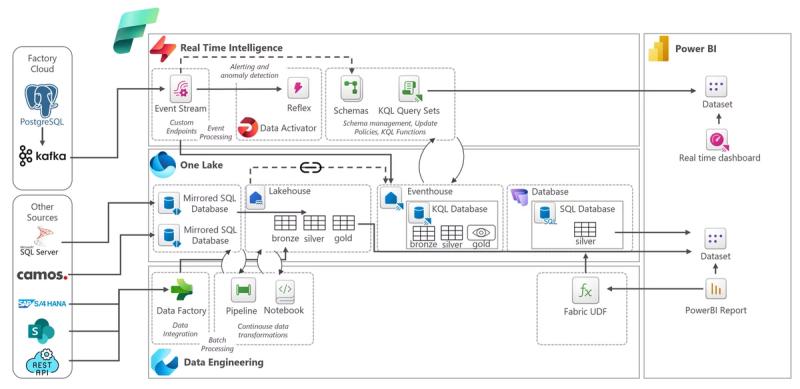
A key project milestone was the setup of the infrastructure using Infrastructure as Code to ensure a scalable, reproducible, and maintainable platform.
To ensure sustainable operations, the project team defined naming conventions, role models, and ways of working. These aspects were especially important to GROB in order to prevent uncontrolled growth and isolated solutions. The relevant data sources were then integrated, transformed, and made available to the business units in a domain-oriented way. Particular attention was needed to harmonize heterogeneous SAP structures and high-frequency IoT data. b.telligent addressed these challenges with a robust data model and coordinated pipelines.
Based on this technical and organizational implementation, the results achieved and the concrete value for GROB are already clearly visible in day-to-day operations. The number of reports has already been reduced by 40%, and the number of users of Fabric data products is now around 300—and continuing to grow.
Voices From the Project
„Thanks to b.telligent’s expert and collaborative consulting, we were able to develop a viable concept together while also enabling our project stakeholders to operate the data platform independently in the future. Changes and new business departments could also be integrated flexibly over the course of the project. The open collaboration with the consulting team was a key component of the project’s success."
– Thomas Brenner, BI Strategy Project Manager, Controller
„With Microsoft Fabric, we were able to create a shared data foundation at GROB-WERKE in a short period of time—one that all business departments can trust. As project lead, I find it especially impressive how much decision-making speed and quality have improved. Instead of spending time gathering data, teams can now focus on content and steering the business. For GROB, the new platform is more than an IT project. It is a true enabler of data-driven work—and the foundation for many additional use cases in the future."
– Florian Stein, Project Lead
b.telligent Services at a Glance
Data Strategy
Joint development of a strategy, including the definition of important use cases and rules of engagement.
Modern Collaboration Model
Connection of business departments and central functions along clear responsibilities.
Future-Ready Data and Reporting Platform
Design of Microsoft Fabric as the foundation for all relevant enterprise data.
Scalable Environment and Consistent Standards
Setup of a stable, scalable environment and introduction of consistent ways of working.
Structured Data Preparation and Provision
Business departments can now access relevant data easily and securely.
Implementation of Business-Critical Use Cases
Project cost reporting, integrated project planning, and real-time analysis of fault messages.
Results & Successes

Highlights
- •Speed – Significantly faster delivery of reports and analyses, enabling decisions to be made more quickly and precisely.
- •Transparency – The Microsoft Fabric-based data platform provides a central, unified view of enterprise data and makes relationships visible across departments and systems.
- •Reliability – A single source of truth and clear governance ensure consistently high data quality and trusted management information.
By implementing this modern solution based on Microsoft Fabric, GROB has already achieved impressive results—while also laying the foundation for continued growth. In the future, all sites worldwide will be able to access relevant information in near real time, manage projects consistently across locations, and gradually implement new data-driven use cases on the established platform.
As the prioritized use cases are implemented step by step, the value of the new data platform is already clearly visible in day-to-day operations. Microsoft Fabric has delivered a significant performance gain in reporting: analyses that used to take several minutes or were only possible through workarounds are now available in seconds.
The central data foundation serves as a single source of truth and enables reliable, cross-functional reporting. Coordination efforts are reduced because everyone works with the same consistent metrics. Fault messages are analyzed in real time, allowing problems to be identified much faster and targeted countermeasures to be initiated.
The solution is highly flexible when new requirements arise, without requiring fundamental changes to the architecture. In addition, clearly defined data governance regulates roles, responsibilities, and quality standards. The value for GROB: greater speed, transparency, and reliability in project management.
Source: b.telligent