

In mining, steel production, or container handling, machines are deployed under extreme conditions. Dust, heat, vibration, and long distances between sites shape daily operations – for example with cranes. A private 5G solution from Siemens Digital Industries provides stable, low-latency data transmission for the remote control of cranes and other machines in harsh environments.
The challenge: Delay-free remote control of machines under demanding operating conditions
Operating industrial and construction cranes places particular demands on the people involved. Crane operators often work at great heights and must keep their eyes on loads at all times. Their work is physically demanding, and a high level of concentration is required. Mistakes can have serious consequences, up to and including a shutdown of operations. Another challenge: crane operators frequently have to cover long distances to reach their workplace, such as at ports or in heavy industry. This makes it difficult to deploy staff flexibly. Hiring new skilled workers is not always possible either.
A pragmatic solution is the remote control of cranes, but it has to work reliably and in real time. In the process, large volumes of data are transmitted. In industry generally, the uplink is decisive, since the bulk of the data is transmitted from the field into a platform or software, such as video data from multiple camera perspectives. A crane operator needs this data in high quality and without delay. At the same time, all control commands must be executed immediately and precisely. Even slight delays can cause problems or compromise safety.
Many wireless technologies quickly reach their limits here. Public mobile networks, for example, are not designed for industrial requirements. They prioritize high bandwidth for many users but offer no guaranteed response times. In addition, stability and data rate can fluctuate sharply at the edges of radio cells. Another potential alternative is Wi-Fi. But it operates in license-free frequency bands and is therefore susceptible to interference from other devices on the same frequency. In industrial environments, this can lead to unacceptable connection dropouts.
Challenges at a glance
- •Extreme environmental conditions such as heat and dust
- •High demands on latency and reliability
- •Unsuitable public networks and interference-prone Wi-Fi
- •Long distances and limited staff flexibility
The solution: Private 5G networks provide a stable communication foundation
Private 5G networks meet industrial requirements particularly well. They are set up locally on a company site, use an exclusive frequency spectrum, and are therefore completely separated from the public network. This creates a controlled environment with high reliability.
Siemens Digital Industries offers a Private Industrial 5G complete solution for industrial requirements, developed specifically for OT and characterized by very easy implementation and operation. As the innovation leader in automation and digitalization, the company supports industrial customers on their digital transformation journey and provides end-to-end solutions with technologies such as Industrial IoT and 5G.
Setting up the private 5G network
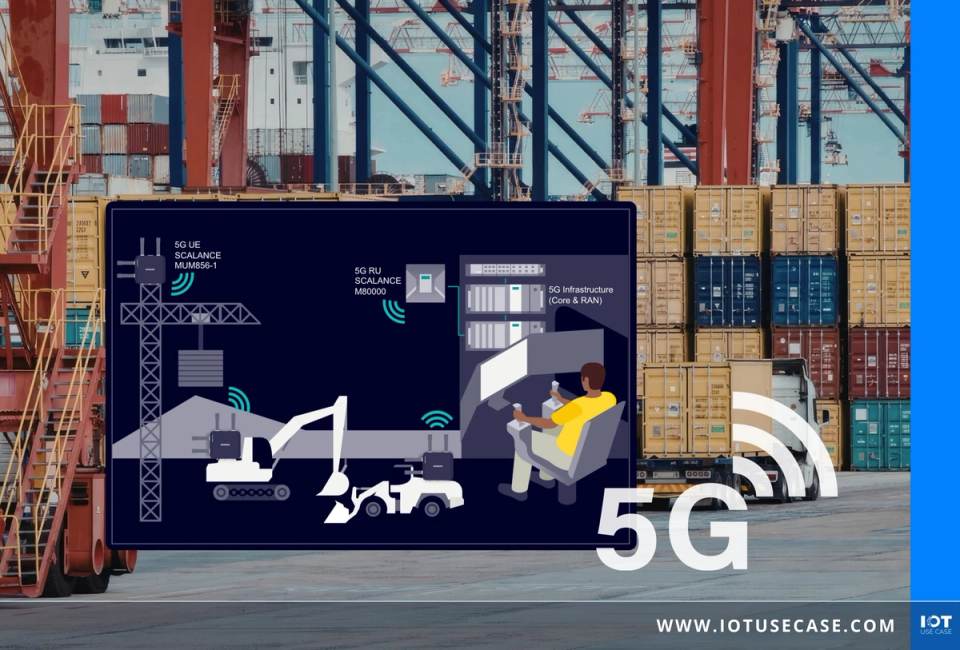
Siemens' solution for communication in demanding and hazardous environments is based on "Private Industrial 5G," a closed system with local infrastructure. It consists of the following components:
- A central 5G core for managing all data traffic
- A Radio Access Network (RAN) for radio transmission
- Radio Units that distribute the signal across the site
The cranes are equipped with 5G routers that serve as the interface to the network. Siemens' system operates entirely on site and deliberately does without cloud connections. As a result, latencies remain consistently low. This characteristic is decisive for an application in which control commands are executed in real time. Response times are predictable and meet industrial requirements for a deterministic connection with guaranteed latencies and no fluctuations in data transit time ("jitter").
Remote control and prioritization of data streams
When remotely controlling cranes in a steelworks or port, the operator sits in a control room at a control desk with several monitors. Cameras deliver live images from various perspectives, so that a complete picture of the work area emerges. The control commands are likewise transmitted to the crane via Private Industrial 5G.
The prioritization of the data plays an important role here. Control data is given the highest priority. It must be transmitted reliably at all times. Video data is treated with lower priority, since small delays are less critical here. In doing so, the ratio of upload to download data is adjusted. The solution also enables the simultaneous use of multiple applications. Different processes can run in parallel on the same network without interfering with one another. This allows operators, for example, to remotely control several cranes at the same time.
The solution makes it possible to cover industrial sites (campus) with just a few radio cells. Within this area, the connection remains stable. Another important advantage of the Siemens solution is the integration of industrial communication protocols such as PROFINET and PROFIsafe. They can be transmitted over the 5G network and thus also enable safety-critical applications. This considerably broadens the range of use and allows integration into existing automation systems.
The result: Greater safety and efficiency through private 5G
Overall, Siemens' private 5G solution offers an architecture designed specifically for industrial requirements. It combines local control with high reliability and forms the technical foundation for modern Industrial IoT applications.
Its use leads to a significant improvement in the working conditions of crane operators. They no longer have to be present directly at hazardous sites, but can work in protected, comfortable control rooms. This reduces health-related strain and lowers the risk of accidents.
Another consequence: a single operator can control several machines. They switch between different installations as needed, without leaving their workplace. This eliminates long journeys across large facilities or in mining operations, which saves additional time and significantly increases flexibility.
In addition, Siemens' technology opens up new possibilities for the further development of industrial applications. The combination of reliable communication and flexible control creates the basis for further automation steps, such as autonomous cranes without direct operation. In this way, private 5G enables a new form of machine control in demanding working environments, one that meets the requirements of modern industry.
Results at a glance
- •Significantly higher occupational safety for operators
- •More efficient use of skilled personnel
- •Reduced travel and lower strain
- •New potential for automation and autonomous systems