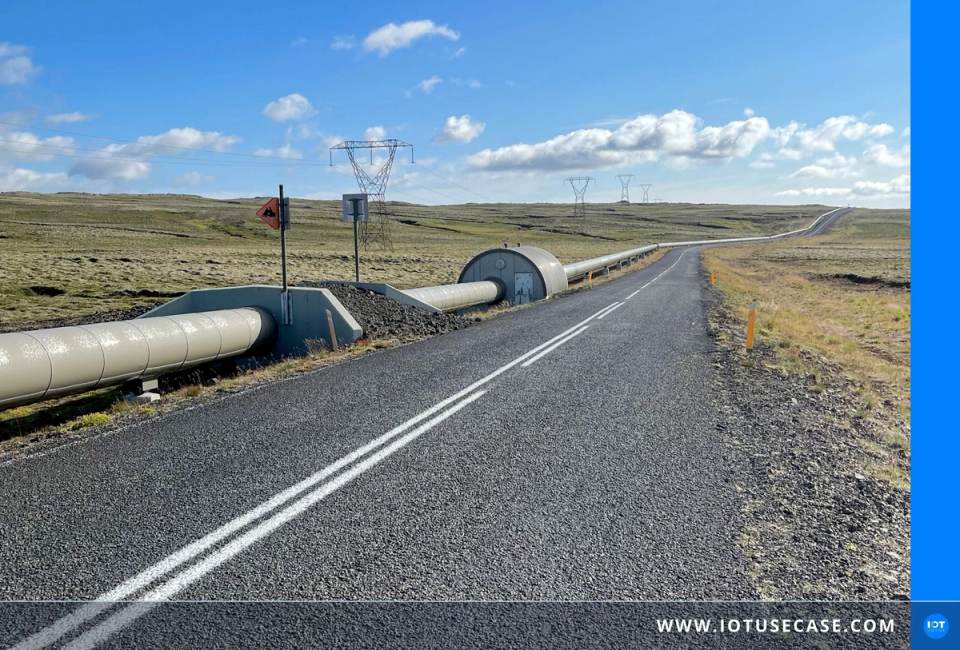
In Iceland, around 90% of households are supplied with geothermal heat. To ensure a reliable hot water supply, the utility operator Veitur Utilities runs an extensive network of pipelines and technical nodes that deliver heat to homes across the country.
To optimize the monitoring of this infrastructure, Veitur Utilities collaborates with the local service provider Rafal. While Rafal handles the technical implementation in the field, akenza serves as the central data hub with its IoT platform. The platform acts as the necessary bridge: it handles device management, normalizes incoming data packets, and ensures seamless integration into Veitur’s existing system environment.
The following cases illustrate how this works in practice: monitoring pressure at remote valve locations and expanding to distributed measurement points in the capital region.
The Challenge: Reliable Distributed Pressure Measurement – even in Remote Areas
When operating geothermal distribution infrastructure, pressure data is a key indicator for detecting and assessing conditions along pipelines early. In the case of the 27 km long hot water pipeline between the Nesjavellir Geothermal Power Station and Reykjavik, pressure at three critical valve points is monitored. The main bottleneck, however, occurred exactly where the data is most crucial: two of these valve stations are so remote that neither power nor traditional communication infrastructure is available – yet, reliable pressure data is required at these points.
Previously, this meant that condition checks required manual inspections and trips to remote sites. This consumes resources, increases operational costs, and extends response times – especially when the pipeline stretches over many kilometers and on-site interventions are not feasible in the short term. At the same time, the risk increases that anomalies remain undetected for too long when data is only available at longer intervals.
Moreover, the required data resolution is not constant. In normal operation, pressure values are sufficient at intervals of several hours, but for more detailed analyses or anomalies, a significantly higher frequency of updates is needed. Without continuous remote transmission, another bottleneck arises: the data collection cannot be flexibly intensified when more transparency is required on short notice.
Meanwhile, Veitur aims to gain more visibility beyond traditional SCADA data and expand data-driven operations and business intelligence. For this, the data must not only be collected but also systematically used, such as to support supply predictions and validate hydraulic models through real-world field measurements.
The central question was:
How can pressure data across pipelines and distribution networks be captured so that the system’s condition can be continuously assessed – even at locations without power and traditional communication infrastructure – and with manageable operational effort?
The Solution: LoRaWAN-based Pressure Data Collection with Platform Integration
To enable reliable remote monitoring of pressure values along the geothermal infrastructure, the project uses a LoRaWAN-based IoT solution from akenza. This solution provides efficient data collection with low power consumption and long-range transmission – ideal for remote locations without reliable communication infrastructure.
The IoT integration is handled by Rafal, while akenza provides the platform for central data collection and processing. The measured values are received on the akenza platform and then integrated into Veitur Utilities’ systems to ensure continuous and efficient monitoring.
Case A: Pressure Monitoring at the Nesjavellir Pipeline
Veitur monitors the pressure at three critical valve points along the pipeline connecting the Nesjavellir Geothermal Power Station to Reykjavik. As a standard, measurements are transmitted at larger intervals; however, when more detailed analysis is needed, the transmission rate can be increased to gain additional insights in near real-time.
Two valve locations are in remote areas with no power or telecommunications connection. To enable continuous data collection, the sensors are battery-powered and recharged via solar panels. The pressure data from 4–20 mA sensors is captured using the Enginko MCF-LW06424 interface and transmitted via LoRaWAN to akenza. From there, the data is integrated into Veitur’s systems to support continuous monitoring.
Case B: Pressure Monitoring in the Capital Region
Beyond the pipeline, Rafal is executing the technical implementation to distribute pressure measurements throughout the city of Reykjavik. The goal is to make predictions about water conditions more precise and maintain a stable supply. Here too, 4–20 mA pressure sensors are connected to akenza via the Enginko interface and transmitted via LoRaWAN.
An additional benefit arises because Veitur uses hydraulic models of the system to prioritize investments. Through remote monitoring, Veitur can verify these models with real field measurements – up to the point where live hydraulic models can run in near real-time and be validated against field measurements.
Rapid Rollout with Simplified Onboarding
An important aspect of the solution is that akenza enables fast sensor registration without programming effort. This feature greatly simplifies the integration and rollout of sensors. In addition, integration with LoRaWAN network providers like Loriot supports the rapid expansion of the measurement infrastructure over larger geographic areas.
The Result: Fewer On-Site Visits, More Reliable Decisions, and Scalable Operation
Through the IoT integration, Rafal and akenza simplify monitoring for Veitur Utilities: system conditions can be continuously tracked without the need for regular on-site trips to remote locations for basic checks. This reduces operational effort and decreases the ecological footprint since on-site visits are required less often.
The availability of accurate (and, when needed, near real-time) measurement data improves decision-making in operations and supports preventive and predictive maintenance strategies. At the same time, Veitur is expanding its IoT initiatives and starting further projects for pressure monitoring in the capital region.
„LoRaWAN technology has enabled us to collect data from locations without power or traditional communication infrastructure, providing reliable and measurable insights and eliminating guesswork."
– Aron Ingi Sverrisson, Veitur Utilities
Outlook: Expansion to Controllable Interventions
In the next phase, Rafal and Veitur Utilities are working on an extension for users with controllable water consumption: remotely controllable valves are planned to shut off supply in case of shortages and more accurately monitor consumption.