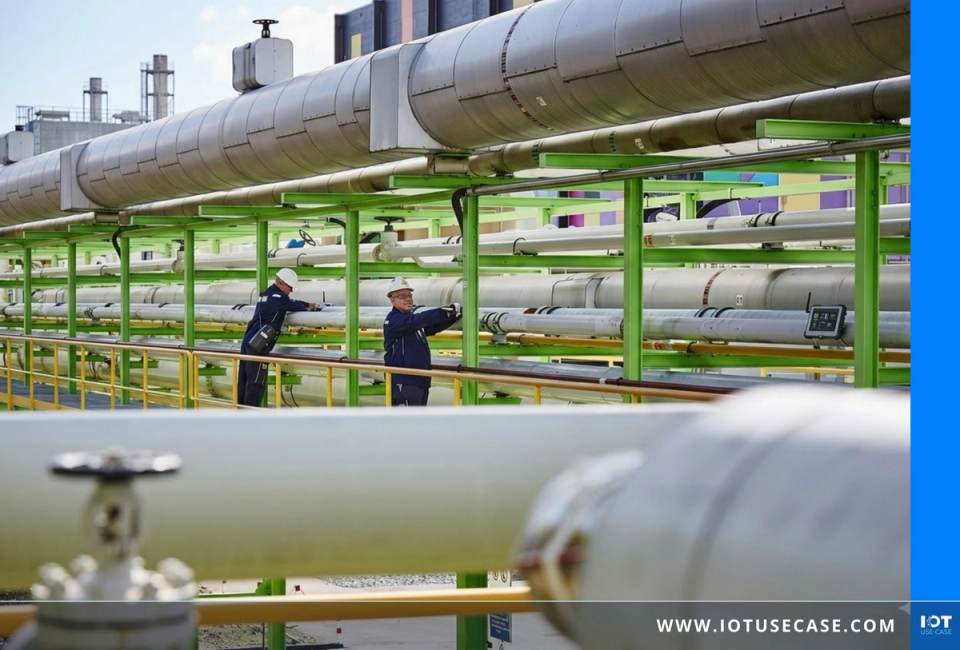
At an industrial chemical site with multiple pressure stages in its steam supply, steam networks have to be operated reliably and efficiently. Steam is a central energy carrier there for process heat and operational processes. To enable data-based control of operations and early detection of losses, Conneqtive has developed and deployed a LoRaWAN®-based monitoring system: SmartDampf.
The solution covers two core tasks: the continuous monitoring of network temperatures as the basis for power plant control, and the automated monitoring of steam traps to detect leaks and condensate backup. In doing so, Conneqtive handles design, installation, operation, and platform integration from a single source.
The challenge: operating steam networks reliably and efficiently without real-time data
Lack of transparency regarding temperature drop in the network
In steam networks with uneven flow distribution, temperatures can vary considerably at different network nodes and endpoints. Without continuous measuring points along the network, the actual temperature drop from the power plant to the consumers cannot be reliably captured.
In practice, this leads power plants to operate with thermal safety buffers. This overproduction is understandable for reasons of supply reliability, but it continuously causes higher generation costs and increased fuel consumption.
Manual inspection cycles in steam-trap monitoring
Steam traps (condensate traps) are safety-relevant components that discharge condensate from the steam network while preventing steam from escaping in an uncontrolled manner. Their condition directly affects the operational safety, energy consumption, and CO₂ footprint of the site.
In many operations, these components are inspected at fixed intervals — typically once a year or quarterly through manual rounds. A defective steam trap can blow through unnoticed for up to eleven months, continuously losing steam, before it is detected at the next inspection cycle. Neither the loss volume nor the economic impact can be quantified promptly without measurement data.
Added to this is the risk of condensate backup: blocked steam traps can cause dangerous water hammer in the piping and lead to plant damage. Early warnings are not possible without continuous measurement.
The solution: LoRaWAN® sensor technology for network temperatures and steam-trap monitoring
Conneqtive designed SmartDampf as a retrofittable LoRaWAN® system that can be operated without intervention in the existing control technology and without connection to the customer network. Data transmission takes place via Conneqtive's self-sufficient LoRaWAN® radio network, while data storage and visualization are handled via the Conneqtive dashboard or through a standardized (MQTT) interface into customer-side systems.
For deployment in industrial chemical operations, the provider brings specific prerequisites: experience with ATEX requirements, knowledge of the safety and approval processes in chemical parks, as well as a LoRaWAN® network designed for operation in such environments. Sensor selection, installation planning, and commissioning are handled by in-house technicians without the need for coordination between multiple trades.
Use Case 1: Network temperature monitoring and dynamic power plant control
Temperature sensors were retrofitted at critical network nodes and endpoints of the steam network. The sensors are mounted onto the pipes by means of a clamp and subsequently re-insulated. The battery-powered devices are designed for surface temperatures up to 500 °C (network sensors) or up to 240 °C (condensate-trap sensors) and are available in ATEX-certified versions for explosion-hazard areas.
The continuously captured temperature data form the basis for a dynamic adjustment of the supply temperature in the power plant. The data also enable the identification of unevenly flowed pipe sections and thermal weak points in the network.
Use Case 2: Steam-trap monitoring for loss detection and plant safety
In parallel, steam traps are equipped with specialized sensor technology that uses ultrasonic and temperature measurement to detect whether a steam trap is blowing through (steam loss) or is blocked (condensate backup). Installation is carried out in a minimally invasive manner directly on the housing screws of the steam traps; a plant shutdown is not required.
If the system detects an anomaly, a notification is triggered immediately in the dashboard. The captured measured values are automatically converted into loss volumes (kg/h) and monetary values and are thus directly available for energy controlling and ESG reporting.
Operation and integration
Installation, commissioning, and ongoing operation are carried out entirely by qualified Conneqtive technicians. This includes firmware updates, platform operation, and field service in the event of component replacement. Conneqtive's LoRaWAN® infrastructure provides connectivity across sites. Via interfaces, the data can be passed on to existing energy management systems or power plant control technology.
The result: a data-based foundation for operational optimization and loss minimization
Network temperatures
Thanks to the comprehensive density of measuring points, the temperature profile in the chemical park operator's steam network can be tracked continuously and automatically for the first time, instead of selectively through manual checks or simulations. The digital data basis also forms the foundation for further algorithms for demand-oriented steam generation.
The model is used on all eight steam networks of the three sites.
Steam-trap monitoring
Defective condensate traps are no longer detected only at the next annual round, but immediately when they occur. The automatic calculation of the loss volume in kg/h and the resulting costs makes the economic relevance of every deviation visible and enables prioritized maintenance planning. At the same time, the early detection of condensate backup protects against water hammer and the associated plant damage.
Overarching effects
The combination of network monitoring and steam-trap monitoring, implemented and operated by Conneqtive, creates a continuous data basis for energy controlling, maintenance, and ESG reporting. Losses are automatically converted into CO₂ equivalents and euros, without any manual data maintenance being required. Conneqtive operates the system as a managed service with clear service level agreements and thereby bears the technical responsibility for availability, firmware currency, and field service over the entire contract term.
The LoRaWAN® trademark is used under license from the LoRa Alliance®.