An IoT retrofit adds digital functions to long-lasting industrial devices, so operators do not have to replace their device fleet and can digitalize legacy devices. A gateway connects older systems to a shared platform and transmits device and process data to web applications and mobile apps. Users monitor the devices remotely and in this way improve process reliability. The climate and temperature control devices of Memmert GmbH + Co. KG are a good example: the IoT retrofit by KURZ Digital connects all devices to a dedicated digital environment.
The challenge: Long service life meets digital requirements
Industrial devices, machines, and plants are characterized by their long service life. As a result, several device generations with different feature sets coexist in many industrial companies. Older devices are not connected, while newer systems are already fully digitalized and can be monitored remotely. Replacing older machines means high investments. This is why companies should digitalize legacy devices and implement an IoT retrofit. One example can be found at Memmert GmbH + Co. KG, based in Schwabach in Franconia, Germany.
Long-lasting legacy devices without data acquisition
Memmert's field of expertise is climate and temperature control devices for laboratories, research, and industrial applications. The portfolio includes, for example, heating and drying ovens, incubators, constant climate chambers, and water baths. The devices are used to test materials under defined temperature conditions or to keep specific ambient conditions constant over extended periods.
Memmert products are designed to run for several hours, days, or even years. At the same time, they are long-lasting capital goods that remain in use for many years. As long as they perform their task reliably, replacing them makes no economic sense. However, older device generations lack functions that are common today. These include remote monitoring, centralized analysis of condition data, mobile applications for accessing the devices, and automatic notifications in the event of errors. Doors accidentally left open, deviations from setpoints, or faults may only be noticed during an inspection round.
Memmert and many other manufacturers in electronics and mechanical engineering face a challenge: they cannot simply replace the installed device base if they want to offer their customers new digital services. At the same time, connecting only the new product generations is not enough in the long run. The risk: two separate product worlds emerge, in which service and maintenance of the older devices have to be handled with considerable effort for years.
Challenges at a glance
- •Several device generations with different interfaces and functions.
- •No remote monitoring and delayed detection of deviations.
- •High investment costs when replacing fully functional legacy devices.
- •Separate service processes for older and already connected products.
The solution: Digitalizing legacy devices and connecting them to the IoT via a gateway
KURZ Digital addresses this situation with a retrofit solution. It connects machines and plants to the Industrial IoT through a digital layer. This makes device data available for monitoring, for backend systems, and for other applications.
Platform, apps, and interfaces connect the device fleet
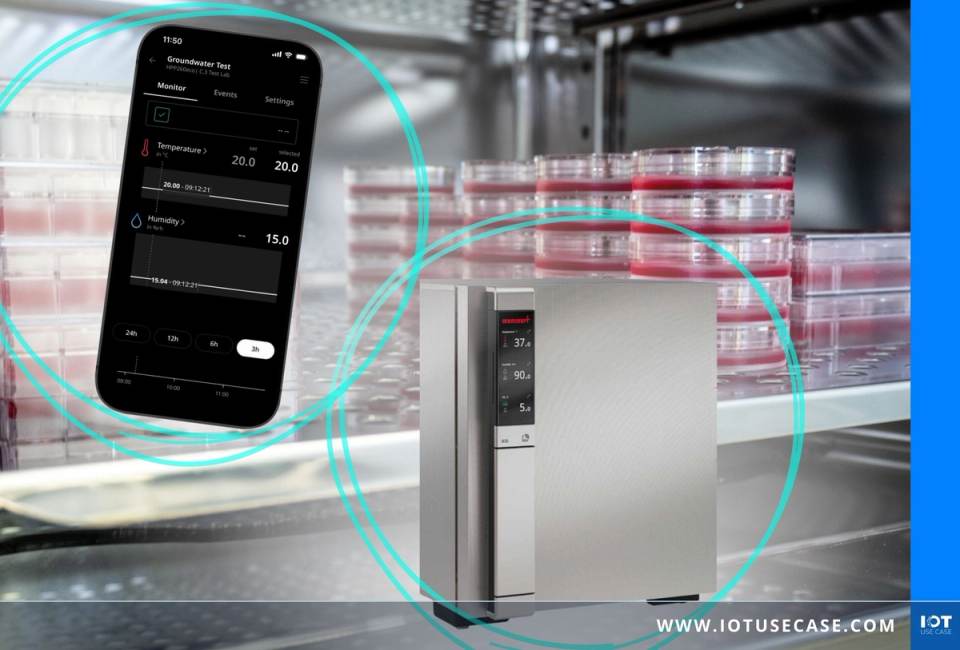
Memmert bundles its digital services under the umbrella brand „myChamber“, which appears to end customers as Memmert's own digital offering. The ecosystem consists of four modules; the Monitoring App and the LIMS integration come from KURZ Digital:
- myChamber Control, the central platform for monitoring and controlling all devices at all sites.
- myChamber Monitoring App, the app for remote monitoring of ongoing processes via smartphone.
- myChamber LIMS, the interface for connecting the devices to a laboratory information management system (LIMS).
- myChamber Link, the interface for integrating device data into the operator's other IT systems.
The IoT retrofit in the narrower sense consists of the Monitoring App and the gateway that connects older devices. The gateway is offered as an option during the purchase process and can be used with both older and newly manufactured devices. For existing devices, it establishes the connection to the digital platform, accesses the available information via the local interface of the respective device, and transmits it to the backend.
The gateway connects to the network infrastructure via Wi-Fi or, alternatively, via LAN. In many cases, this means an existing infrastructure can be used. With good wireless coverage, Wi-Fi offers a simple connection.
Where massive walls or concrete ceilings interfere with the wireless signal, the wired Ethernet connection is used. All connections are encrypted and thus protected against cyberattacks.
Capturing measured values, program data, and events centrally
The standard measurement interval is 30 seconds and can be configured. When reading out data, the solution distinguishes between measurement data, program data, and events.
- Depending on the device type, up to 13 measured variables can be processed. These include temperature, humidity, oxygen, and carbon dioxide. Added to this are values for vacuum or fan speed. The platform processes the setpoints and actual values as well as the defined alarm limits.
- In addition, the system transmits program data. It shows the current program status of the device. This includes the operating mode and the expected end of the program.
- The third data group is logged events, such as alarms, warnings, and information messages. For such events, the system can immediately trigger a push notification or an email to users.
On the application side, the solution separates two frontends. The web-based dashboard is purely internal to the manufacturer and is used to manage devices and users. End customers work exclusively with the mobile apps for iOS and Android. There they register, assign their devices themselves, and then retrieve the device data.
Remote monitoring and alerting from the cloud
The KURZ Digital solution primarily serves to monitor the device fleet and present information about the device status. The apps show the current status and provide information about relevant events. This makes it possible to see whether values are within the intended limits or whether action is required.
Alerting is an important element. If a measured value deviates, the system triggers a corresponding event. The same applies to warnings or other relevant messages from the device. Users can be notified via push notification on their smartphone or by email.
The solution's backend runs in a cloud environment. KURZ Digital does not commit to a fixed hosting partner. The architecture can easily be adapted to the requirements and the existing cloud strategy of the respective manufacturer. In addition to numerous cloud providers, the solution can also be operated in a manufacturer's own infrastructure. This model is aimed, for example, at companies with special requirements for data storage or compliance, such as energy or water utilities. Furthermore, the solution can be operated in the KURZ Group's data center if required.
The mobile apps are an important part of the IoT retrofit. KURZ Digital takes different requirements for their distribution into account. The familiar app stores for iOS and Android can be used. However, it is equally possible to use internal app stores of companies or third-party platforms.
White-label model extends hardware with digital services
The model can also be used for machine builders and other manufacturing companies. KURZ Digital offers it as a white-label solution that any user can equip with their own corporate identity. If desired, it can also be set up modularly and, for example, initially be used only as a monitoring tool. The company can market this solution to end customers as its own digital offering. In this way, a classic hardware product can become a product with a complementary digital service.
The manufacturer does not need to build up its own IT expertise for this. At the same time, it continues to present itself to users under its own brand. Through the registration and use of the platform, the manufacturer gains insight into which devices are registered for the digital solution.
The result: Using old and new devices together digitally
With the IoT solution from KURZ Digital, devices that previously operated largely locally become connected products. Operators can view the status of their registered devices via PC or smartphone without having to be on site. At the same time, this creates an industrial product with an additional digital usage layer that enables the analysis of operating parameters.
Industrial companies do not need their own IoT infrastructure for this. The IoT solution is a turnkey, integrated solution. It reduces the internal development effort and the need for in-house specialist knowledge. The retrofit approach also protects existing investments. Devices that are already installed, still on sale, or in stock do not have to be replaced in order to use digital functions. A user can thus operate old and new device generations in a shared environment.
For mid-sized companies in particular, the IoT retrofit is a way to gradually add digital services to existing portfolios. If desired, the platform can be extended so that a manufacturer offers additional remote monitoring functions or an automated connection to customer service. At Memmert, this is deliberately not implemented: the devices' measurement data remains visible exclusively to the customer, and Memmert itself has no access to it.
In such an extended scenario, the manufacturer receives additional condition information and can assess a fault more precisely. It is then often possible to fix a problem remotely, without any travel. If a technician does have to visit the operator, the appointment can be prepared in a more targeted way based on the available information. The solution can thus make service calls more efficient or even avoid them entirely.
Because different hosting options can be used for the backend, the platform can be adapted to individual requirements, for example regarding data storage, compliance, and digital sovereignty. It also enables the development of a company's own digital services, which can become the basis for new business and service models, for example as a paid service offering.
The IoT retrofit from KURZ Digital can be transferred to many other industrial products in a wide range of industries. In principle, the approach is suitable for long-lasting machines, devices, and technical equipment, provided their data can be read out or suitable interfaces can be created.
Results at a glance
- •Joint monitoring of old and new device generations.
- •Remote access to measured values, program status, and alarms.
- •More efficient service thanks to condition data and remote diagnostics.
- •New digital services without a dedicated IoT infrastructure.