




A retail company with more than 600 locations and over 2,000 employees operates one of the largest store networks in Germany. As energy costs continue to rise and sustainability requirements grow, an area that had previously received little attention came increasingly into focus: high energy consumption across its stores.
With an IoT-based solution from PSsystec — one that could be integrated quickly and scalably into the existing store landscape without requiring local IT infrastructure — the retailer was able to establish cross-site energy management that delivers reliable data and surfaces numerous optimization opportunities. The project was supported by PSsystec partner TRIBICON, who contributed valuable expertise through energy consulting and funding advisory services, among other areas.
The challenge: lack of transparency across a distributed store network
The initial situation was marked by significant structural complexity. The store network comprised more than 600 locations with widely varying structural and technical conditions. Many stores were housed in leased, retrofitted existing buildings with outdated infrastructure. Under these conditions, a uniform IT integration was barely feasible.
In addition, energy-intensive systems such as refrigeration, HVAC, lighting, and heating drove substantial costs. Load peaks and unnecessary base loads — for example, from systems running continuously outside operating hours — further increased energy consumption.
The heterogeneous site structure made it difficult to capture and evaluate energy consumption consistently across stores. As a result, building a reliable data foundation for identifying inefficient consumers and deriving targeted measures was only possible with considerable effort. Regulatory requirements such as ESG criteria, CSRD reporting, and the implementation of an energy management system in accordance with ISO 50001 could likewise only be met inadequately.
On top of this came clear requirements for implementation: the solution had to be deployable without extensive training, highly scalable, and — above all — operable without interrupting day-to-day store operations.
The Solution: IoT-Based Energy Management with Non-Invasive Sensors
To address these challenges, the retailer implemented IoT-based energy monitoring tailored specifically to the requirements of distributed store networks. The goal was to create end-to-end data transparency with minimal installation effort and to derive concrete optimization measures from it.
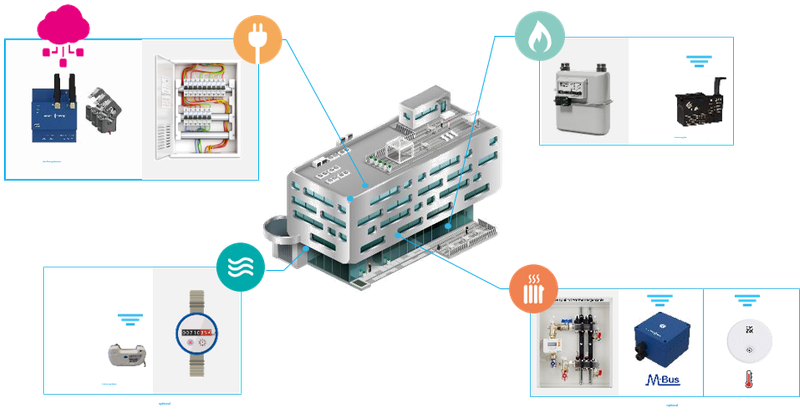
The technical implementation is built on the PSsystec IoT Energymonitor combined with non-invasive sensors that read existing meters for electricity, gas, water, and heat without requiring any modification to the existing infrastructure. Installation of the IoT Energymonitor was carried out plug-and-play and was typically completed within roughly two hours per site — with no need for IT specialists and no disruption to ongoing operations.
The captured data is encrypted and securely transmitted via an integrated wireless network (868 MHz) to Deutsche Telekom's PSA-certified Cloud of Things platform. In addition, BLE-based sensors are used to record temperature data in sales floors, storage areas, and at checkout zones — for example, to ensure optimal storage conditions or to improve occupational safety.
In the cloud, the data is centrally aggregated and analyzed. The solution makes it possible to continuously capture load profiles and to identify load peaks, unnecessary base loads, and inefficient consumers. On this basis, targeted optimization measures can be derived — for example, by adjusting operating hours or by managing HVAC and lighting systems according to actual demand.
The system also lays the foundation for energy management in accordance with EN ISO 50001 and supports compliance with ESG and CSRD requirements. Complementary services such as metering point concepts, energy consulting, and support with funding applications round out the IoT provider's support offering. The solution is also eligible for BAFA funding, which can further reduce investment costs.
This is where TRIBICON came in. The experts at this engineering firm for technical energy services supported the retailer with their domain expertise. TRIBICON provides companies of all kinds — effectively acting as an external energy department — with the consulting they need on topics such as energy, funding, and ISO 50001 management systems. The operation of smart metering points and the development of energy procurement strategies also form part of the provider's service portfolio.

The outcome: clearly measurable savings in energy and operating costs
The rollout of PSsystec's IoT energy monitoring, combined with the accompanying consulting from TRIBICON, has given the retailer full transparency into energy consumption across its entire store network for the first time. Energy flows can now be analyzed and benchmarked across sites, allowing inefficient processes to be identified and optimized quickly.
The results are clearly measurable: energy costs were reduced by 5 to 10 percent, while overall operating costs were brought down by up to 30 to 40 percent through optimized controls and more efficient use of equipment. At the same time, load peaks were reduced and unnecessary continuous loads eliminated.
The solution is also delivering results in the area of sustainability: the improved data foundation enables sound carbon accounting and makes it easier to meet regulatory requirements.
Another decisive advantage lies in scalability: as demonstrated at the retailer in question, the solution can be rolled out to hundreds of locations with minimal effort and adapted flexibly to varying conditions. The result is a future-proof energy management approach that combines economic efficiency with sustainability.
Results and Benefits of the Solution at a Glance:
- •5 to 10% lower energy costs through transparent consumption data
- •30 to 40% reduction in operating costs through optimized controls
- •Full transparency across all energy flows in the store network
- •Rapid identification of energy hogs and load peaks
- •Significantly improved carbon footprint and a solid ESG/CSRD data foundation
- •Fast rollout without local IT infrastructure (approx. 2 hours per location)