

How emptying data, event logic, and billing processes converge into an end-to-end platform solution
Initial Situation and Project Objective
A service provider in municipal waste management operates in more than 230 cities and is responsible for waste disposal logistics for around 700,000 households. More than 80,000 of these households already use a dedicated waste collection system. The goal of the next expansion stage: capture consumption data more precisely, allocate costs based on actual usage, and leverage operational data as a foundation for additional services.
The company commissioned doubleSlash to develop a new service platform. The task was to integrate billing logic, data flows, system architecture, and software development in such a way that emptying and metering data are turned into automated, usage-based individual billing — while at the same time establishing a scalable foundation for monitoring and data-driven services.
Digital twins as a technical foundation – and their limits without process logic
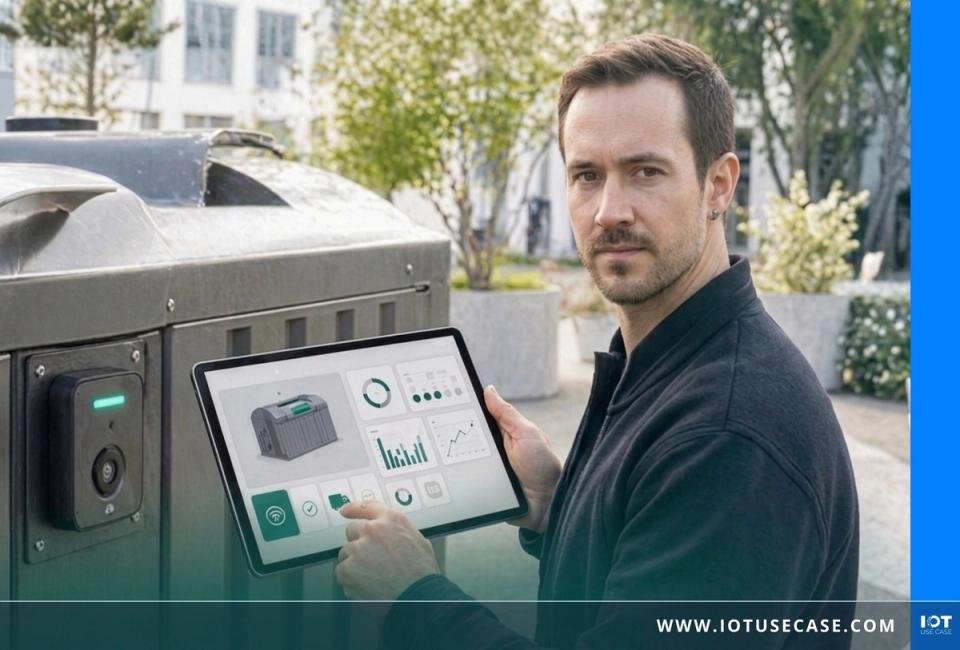
Digital twins provide a technical representation of real-world objects and processes — in this case, the waste access controls in operation. This representation initially lacks business usability: metering data and event streams only generate value once they are linked with billing logic, customer master data, and domain-specific processes.
The specific implementation model comprises the following steps:
- Waste access controls are represented as digital twins within the system.
- Emptying and metering data flow continuously into a structured process chain.
- Usage volumes are captured precisely, device-specific and time-accurate.
- Billing is generated based on actual consumption per unit.
- Operational data is made usable for monitoring, analyses, and additional services.
Challenge: Heterogeneous Data Sources, Billing Logic, and Scalability on a Single Platform
The central challenge did not lie in the sensor technology, but in linking heterogeneous data sources into a closed process. Event and emptying data from ongoing operations had to be processed and combined with master data in such a way that legally compliant, traceable individual billing could be generated.
Added to this was the scalability requirement: the platform should not only cover current operations, but also grow with an increasing number of devices and new application areas. The domain model, system architecture, and interface logic therefore had to be designed for extensibility from the outset.
Implementation: design and development of the service platform by doubleSlash
doubleSlash was responsible for the design and development of the service platform. The starting point was the structuring of the functional requirements and processes. On this basis, data flows were modeled, system interfaces specified, and customer data, emptying data, and billing logic merged into an end-to-end workflow. Usability and UX were taken into account for operational use; testing, data migration, and commissioning ensured data quality and process stability.
Technological building blocks: ActiveDB and OpenInformer
ActiveDB (bill-X) serves as the operating system for live digital twins. The waste access controls are digitally represented within it; event data is processed in real time and made available to downstream systems.
OpenInformer (bill-X) handles the functional downstream processing: the delivered data is turned into consumption-accurate, automated billing at the level of individual units.
Business value only emerges from the interaction of both systems: doubleSlash transferred the domain model onto ActiveDB and OpenInformer and specified the interfaces in such a way that the client's business logic is mapped end-to-end and reliably.
Results: Billable Operational Data and Scalable Platform Infrastructure
With the platform now in production, an end-to-end process chain is available — from the waste access control to billing. The key results:
Billing directly from IoT data Emptying and consumption data form the basis for usage-based pay-per-use billing — automated, transparent, and traceable at the level of individual units.
Reduced manual effort Automated processes replace manual steps in billing, operations, and customer service, thereby reducing sources of error.
Operational transparency in real time Usage, utilization, and deviations of the connected waste access controls are visible at any time. Monitoring data enables continuous operational control.
Scalable infrastructure Currently, around 250 sensors are connected. By the end of 2026, around 3,000 devices are projected — the platform architecture is designed for this growth.
Foundation for further services The captured operational data creates the prerequisites for predictive maintenance, simulations, analyses, and additional data-driven offerings — also beyond waste management, for example in the fields of energy or mobility.
Transferability of the approach to other application areas
The principle of usage-based billing built on digital twins is not limited to the waste industry. It can be applied wherever usage can be measured and costs are to be allocated according to actual consumption. The prerequisite in each case is the end-to-end linking of sensor and event data with domain logic and billing systems.