Groupe Renault’s plan is to implement the use of OPC UA-capable devices and systems at all production sites worldwide, and to realise seamless information exchange from sensor to machine to cloud and back using the OPC UA digitalization standard. OPC UA is already deployed at 17 of the 38 manufacturing sites with a total of 3,300 OPC UA-capable devices.
The start of the digital transformation at Renault dates back to 2016 at the Valladolid plant in Spain, where numerous digital pilot projects of an initial character for automotive production were launched. Other production sites in Turkey and Romania also began focusing on digital projects at almost the same time.
As early as 2017, Renault recognised that the OPC UA digitalization standard provides the necessary prerequisite for efficiently networking data from a wide variety of machines and operating systems. The integration of OPC UA-capable components and systems has been actively driven forward ever since.
OPC UA in brief
- •OPC UA (Open Platform Communications Unified Architecture) is the globally established open platform for semantic interoperability and industrial digitalization.
- •With standardized information models, OPC UA enables the consistent digital representation of machines, products, plants and factories across their entire lifecycle – from sensors and controllers through edge systems to the cloud and beyond company boundaries.
- •This makes OPC UA the foundation for digital twins, the Digital Product Passport, AI applications and interoperable data ecosystems.
- •Transport – whether TCP, UDP, MQTT, APL, SPE, 5G or TSN – is just one of several capabilities; security is built in from the ground up.
Groupe Renault on the road to the Smart Factory
The control, optimisation and profitability of cross-site manufacturing based on secure real-time data represents the future of automotive production.
GOALS ON THE PATH TO DIGITALISATION
As early as 2017, a group of OT, IT, device and software experts defined five concrete targets for the digital transformation of automotive production across the entire group. These goals included a connected workforce, data-driven real-time operations, Processes 4.0, flexible supply chains and equipment, and full traceability of components.
Making the vision of intelligent automotive production a reality was the ambitious future scenario. M2M communication, cloud applications, big data and machine learning were all part of the vision, along with AI and digital twins.
HURDLES ON THE PATH TO DIGITALISATION
The automotive industry uses highly specialised production equipment. Renault uses different assembly systems, maintenance systems, test equipment, welding machines and industrial robots, each with their own specific operating systems. Some systems have been in use as legacy systems since the 1980s.
A major challenge at the start of the digitalisation offensive in 2016 and 2017 was therefore the lack of interoperability between the systems. Connecting the established systems with different operating systems was not straightforward. In addition, interoperable interfaces had to be integrated and a uniform data structure and communication protocols had to be developed so that production could even access standardised data.
The vision of the intelligent factory and profitability was initially dominated by the search for a suitable IT architecture. Groupe Renault decided to build the digitalisation of production on the foundation of OPC UA technology and OPC UA-based Companion Specifications. In addition, Groupe Renault developed its own data models for various processes.
Global digitalization standard for the automotive industry
What can OPC UA do?
OPC UA is the secure, semantic standard for industrial digitalization. Standardized information models describe machines, products and plants across their entire lifecycle – from the sensor through edge systems to the cloud and beyond company boundaries. Transport (including TCP, UDP, MQTT, TSN and 5G) is just one of several capabilities. The letters OPC UA stand for Open Platform Communications Unified Architecture (IEC62541). This is an IT architecture that can be integrated on different operating systems. Data is provided by OPC UA servers. The OPC UA client or subscriber can access this data. A system can be both server and client at the same time.
What makes OPC UA efficient?
The architecture is platform- and manufacturer-independent. OPC UA describes machine data semantically, making it unambiguously interpretable across manufacturer and system boundaries. On this basis, OPC UA represents a globally uniform standard for bidirectional information exchange.
WHAT IS PART OF THE OPC UA TOOLKIT?
Standardized information models, simple interfaces, flexible extension options and security by design. OPC UA thus offers an adaptable architecture that can flexibly and quickly adapt to new developments in industrial automation. From sensor to cloud and back in real time is OPC UA’s recipe for success.
The advantages of a uniform data model are of significant benefit across manufacturers throughout the entire automotive and supplier industry.
Google Cloud Platform
„We are honoured to support the OPC Foundation. Our membership underscores Google Cloud’s commitment to openness and collaboration with industry. With OPC UA, we will incorporate machine data into our data analytics and AI capabilities to ultimately promote new capabilities and performance in the factory. By driving AI across the entire value chain, we want to offer flexibility and choice at industrial scale."
– Dominik Wee, Managing Director Manufacturing, Industrial and Transportation, Google Cloud
ADAPTERS SHOW THE WAY
To ensure a uniform data structure, gateways or adapters for machine data are used for the existing machines. MQTT is used to distribute OPC UA sensor data (publication topics) and sensor configuration (command topics). This enables both the transmission of monitoring sensor data to the cloud and the control of machines with sensor data from the cloud. Groupe Renault uses the Google Cloud Platform to collect the data.
RENAULT MAKES ITS DECISION
These advantages were decisive for Renault’s expert group in integrating OPC UA as a cross-plant digitalization standard. The OPC UA information model gives Renault uniform access to data from divergent controller types. OPC UA provides data security in communication, fast data processing, reliable and contextually accurate data delivery, a uniform data structure specification and high scalability.
The decision to integrate OPC UA as a digitalization standard was initially motivated primarily by manufacturer-independent data exchange. Today, OPC UA is one of the most important building blocks for the vision of the intelligent factory.
OPC UA IN PRACTICE AT GROUPE RENAULT
INDUSTRIAL DATA MANAGEMENT 4.0
Groupe Renault uses the data structure descriptions (OPC UA Companion Specifications) developed by the OPC Foundation and its partners, as well as its own data models. Additional extensions for the machine level (Unified Data Collector) and the aggregator level (DFA, Data for Aggregator) come from Groupe Renault itself. For example, the extensions relate to device identification and device location.
The ‘Industrial Data Management 4.0’ (IDM 4.0) platform, which has existed since 2019, enables data from a wide variety of sources to be captured. The data is contextualised, structured and aggregated, and made available as big data for control and analysis purposes.
In mid-2020, the Renault-Google Cloud Partnership started with the transfer of Groupe Renault’s OPC UA data models to Google Cloud’s BigQuery. Based on the OPC UA infrastructure, Groupe Renault is able to effectively monitor and control all 17 sites, factory processes and machines worldwide in real time.
HOW ARE LEGACY SYSTEMS CONNECTED?
The integration of data and protocols from different production components and legacy systems is a necessary step towards automation and digitalisation. Without this step, it is hardly possible to increase productivity. Renault solved this problem by equipping legacy components and systems with adapters, thus enabling controllers, data formats and protocols from different manufacturers to achieve OPC UA capability.
Working with partners, Renault developed an IoT box in which the specific data protocols of the individual components are transformed to the OPC UA standard. Regardless of the platforms, production can now access standardised device information.
CONNECTING NEW COMPONENTS, TOOLS OR SYSTEMS
When new components or systems are integrated into production, they already come standard with an OPC UA interface. The connection of new devices to the existing OPC UA infrastructure is therefore straightforward. Renault also calls on suppliers to deliver systems and components with OPC UA interfaces in order to continuously increase the proportion of components with OPC UA interfaces.
Intelligent tools
Groupe Renault has set itself the target of reducing the failure rate of all components to 0.5 per cent of operating time. According to Renault, significant savings have been achieved in six out of ten workshops where devices with OPC UA interfaces were used.
ELECTRIC SCREWDRIVERS
Renault uses servo-controlled electric screwdrivers in automated or manual manufacturing that use different protocols and generate data depending on the manufacturer (such as process code, order number and energy consumption). Groupe Renault’s IoT box is used to convert the specific protocol to OPC UA.
Three different brands of screwdriver controls are currently connected, and Renault is preparing to add two more to the list. More than 500 screwdriver controls are currently connected. The new data protocols contain information such as motor number, screwdriver type, torque and values used when tightening screws. Since 2019, Renault’s suppliers have also committed to manufacturing OPC UA-capable electric screwdrivers.
BATTERIES
In 2018, 80,000 measuring points for determining battery charge levels were equipped with adapters and thus made OPC UA-capable. Result: charge states of the batteries of all vehicles are transmitted in real time using OPC UA.
WELDING ROBOTS
Components such as CNC, PLC, welding processes, robots and other industrial components are made OPC UA-capable via adapters. This applies to data types such as Boolean values, timestamps, analogue values and image and table data. OPC UA offers particular advantages in automated component welding, as an exact power and voltage supply must be ensured. If the voltage is too low and the temperature too low, a so-called ‘sticky point’ occurs, which has a negative effect on the quality of the welded components.
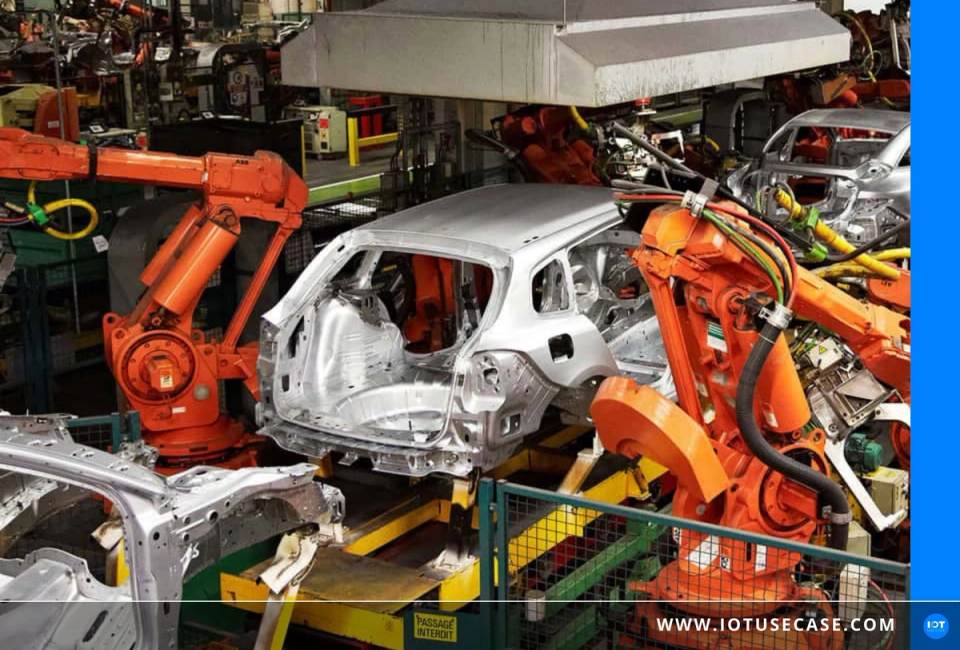
Using the data collected by the 2,200 networked robots in the bodyshop, Renault is able to efficiently monitor welding processes, detect irregularities in real time and intervene, or carry out predictive maintenance on the components. Failure rates in welding processes have fallen by 20 per cent.
OPC UA for automotive manufacturers
EXPANSION OF OPC UA USE
OPC UA on its way to becoming the international industrial network standard for automotive manufacturers and their suppliers.
Groupe Renault is continuously expanding its use of OPC UA. In machine-to-machine (M2M) communication and human-machine interfaces (HMIs), OPC UA has achieved ‘promising results with low implementation effort’ according to Groupe Renault. New process, manufacturing and quality data is being made accessible via OPC UA-capable devices. As the use of OPC UA expands, Groupe Renault gains access to more and more data. According to Groupe Renault, more than 1 billion messages per day will be transferred to Google Cloud from the first quarter of 2021. The volume of available industrial data is expected to increase tenfold by the end of 2023.
OPC UA AS AN INTERNATIONAL STANDARD FOR THE AUTOMOTIVE INDUSTRY
The integration of OPC UA interfaces in automotive manufacturing is being further driven by Renault. In 2019, the use of OPC UA was introduced for machining systems, lathes and milling machines as part of the ‘Connected Plant’ project. More and more suppliers are integrating OPC UA interfaces into devices and on-board software.
Renault’s vision: an international digitalization standard for automotive manufacturers and their suppliers built on OPC UA with uniform information models.
Source: OPC Foundation