
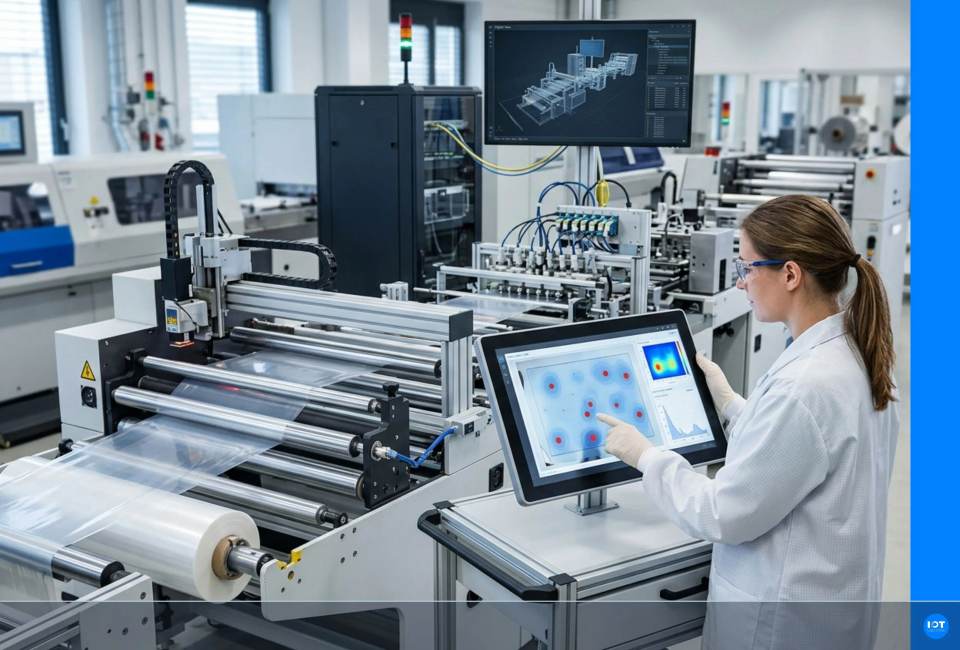



In manufacturing, quality problems often arise across multiple machines and process steps. Final inspection then only reveals that a component is defective — yet the cause of the defect frequently remains unknown. KURZ Digital's Process Data Analysis brings together machine, process, quality, and inspection data and assigns it to individual components. This allows production to react faster and to gradually bring processes closer to the optimal production run (the "Golden Run"). The flexible software is adapted by the developers during installation to the conditions of the respective industry and company.
The challenge: defect causes often remain hidden
In many manufacturing processes, the cause of a defect can often only be identified once several work steps have been completed — at considerable cost in materials, machine time, and labor. Many parts have to be reworked or even scrapped.
Precise manufacturing matters for touch sensor films
A good example is the touch sensors in smartphones, industrial HMI touchscreens, and the displays of modern vehicles.
Depending on the design, the touch sensor system sits directly beneath the cover glass or is integrated into the display stack-up. It contains fine, transparent conductor structures that detect touch capacitively and must be manufactured with high precision. They must also not create any optical distortions on the displays.
This makes one thing clear: small deviations have major effects. Dust particles, microcracks, unsuitable layer thicknesses, or dimensional deviations can impair the function and quality of the touch sensor system. In such cases the part is scrap — in practice usually referred to as a bad part. If too many of these occur, production is no longer cost-efficient.
Data silos hamper root-cause analysis
In industrial production, two problems frequently occur: either the quality of the manufactured parts is poor, or the output quantity falls short of expectations. In both cases, a clear view of the interdependencies within the production process is often missing. Companies then frequently don't know exactly where the problem arises and which parameters have the greatest influence. This question is hard to answer when the necessary data is stored across many silos.
Such process parameters include, for example, temperature, pressure, the machine's operating speed, mechanical forces during production, storage times, and the quality of the raw material or intermediate products. Traditionally, this data is evaluated after the fact, for instance using Excel. With large data volumes, however, this quickly reaches technical limits and is very time-consuming.
Challenges at a glance
- •Defect causes remain hard to identify in multi-stage processes.
- •Final inspections often reveal defects only after production is complete.
- •Data silos make fast, reliable analysis difficult.
- •Manual analysis reaches its limits with large data volumes.
The solution: live data creates transparency in the process
KURZ Digital's Process Data Analysis enables live evaluation of key production parameters. To do this, the software integrates a wide range of existing data sources and presents the results in dashboards.
Digital twins consolidate manufacturing data
The Process Data Analysis evaluates machine parameters, process data, quality data, data from ERP, M2M, MES, and QMS applications, recorded alarms, measurement data, and optical inspection results in near real time. This information is combined into a digital twin of a component or a production unit. Based on the relevant data from the individual process steps, it shows the conditions under which a good part or a bad part was produced.
The digital twin makes the analysis more precise than looking at the machine alone. It links current measurement values with the components, the existing quality data, and the process context. Users of the solution can select time periods for displaying the data, examine individual process steps, compare machines, and zoom into the data. This reveals which parts still lie within the tolerance ranges defined in advance. By adjusting the relevant parameters, manufacturing quality can be raised step by step.
AI determines stable manufacturing boundaries
The Process Data Analysis uses various AI methods that help carry out the analysis of process data more efficiently and accurately. Depending on the use case, data availability, and target outcome, different AI algorithms are applied:
- Pattern recognition for analyzing irregularities (anomalies) in production data.
- Quality predictions and forecasts of process values, in order to detect deviations early.
- Cluster analysis for process optimization, for example to determine optimal process parameters for reproducible quality.
A visual representation shows which combinations of process parameters are stable and which lead to scrap. The goal is to gradually guide the production process toward the "Golden Run" — an ideal production run with optimal parameters and high quality.
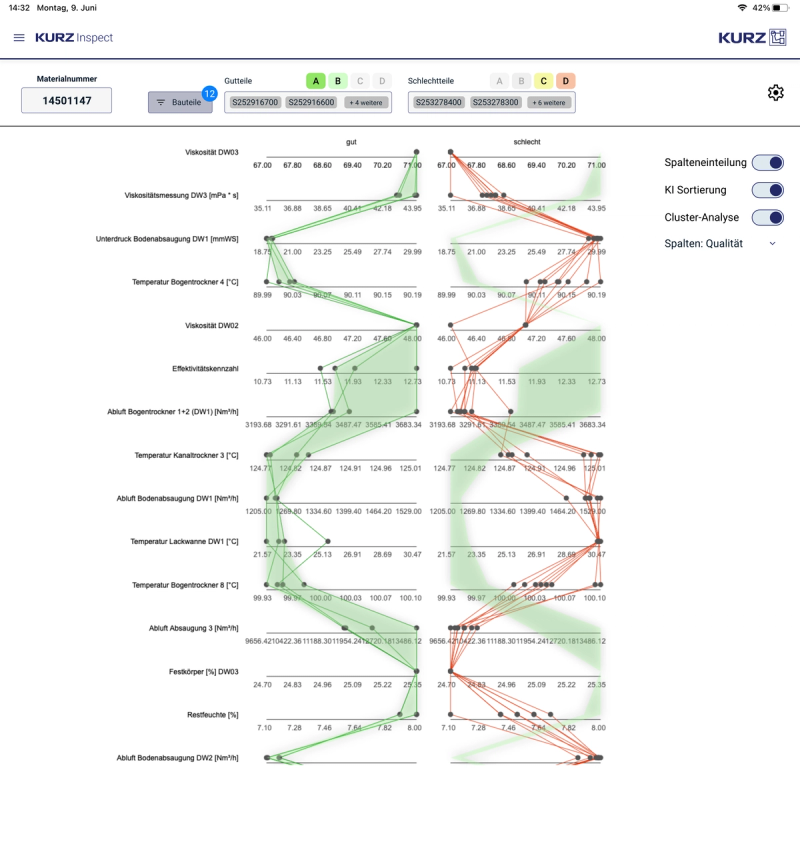
A concrete example of this is the production of touch sensor films. The solution can analyze at which point a film goes from good to bad. Defect points are then shown on a visualization of the film. Many defects in touch films are difficult to detect with the naked eye. A purely manual visual inspection can easily overlook such defects, whereas the digital analysis records them systematically and assigns them to the respective process step. Users can zoom into the visualization, click on individual defects, and view the associated camera images from production.
Flexible connection to different production environments
KURZ Digital's Process Data Analysis software connects different systems and adapts to various machines, interfaces, and processes.
- The solution can be operated flexibly. It can run on-premises on existing servers or be installed on an industrial PC. For larger projects, an on-premises solution on a dedicated server makes sense. Machine learning models run directly on the machines where required. A cloud solution is possible on request.
- The solution can also be used in smaller installations, for example on a small manufacturing cell or with just a few machines. Smaller production environments can therefore benefit from the Process Data Analysis as well. At the same time, the solution is scalable and grows with the manufacturing operation.
- Using the solution requires access to the machine data, for example via standardized interfaces such as OPC UA. Older controllers or proprietary interfaces can also be connected.
- Data sovereignty remains with the customer. If a suitable data foundation already exists, KURZ Digital builds on it — no new database or platform is introduced. If no data foundation exists, a dedicated data layer is set up.
- A frontend is provided for visualization. Dashboards, views, and user interfaces can be tailored to the customer's specific needs.
The result: Predictive Quality reduces scrap
The most important benefit of the Process Data Analysis is more stable manufacturing. It enables companies to identify which process parameters influence quality and which deviations lead to scrap. This increases process stability, because deviations are not merely documented but continuously assessed.
A further result is Predictive Quality during the ongoing process. The solution works while manufacturing is in progress and indicates early on whether a process is developing critically. As a result, quality management shifts from purely after-the-fact inspection toward predictive process control. Production detects critical developments early and receives feedback directly at the machine or on mobile devices.
This gives rise to an effective course of action. First, the relevant data sources are identified and connected. Next, components or production units are mapped digitally and compared with the quality data from good and bad parts. Machine learning is used to identify key quality parameters and derive stable manufacturing boundaries. On this basis, companies can optimize their entire manufacturing operation.
Results at a glance
- •Process data is consolidated on a per-component basis.
- •Defects and bottlenecks can be pinpointed more precisely.
- •Quality limits become more identifiable using AI methods.
- •Scrap, rework, and production stoppages can be reduced.
Learn more here: https://kurzdigital.com/en/solutions/process-data-analysis-with-ai