
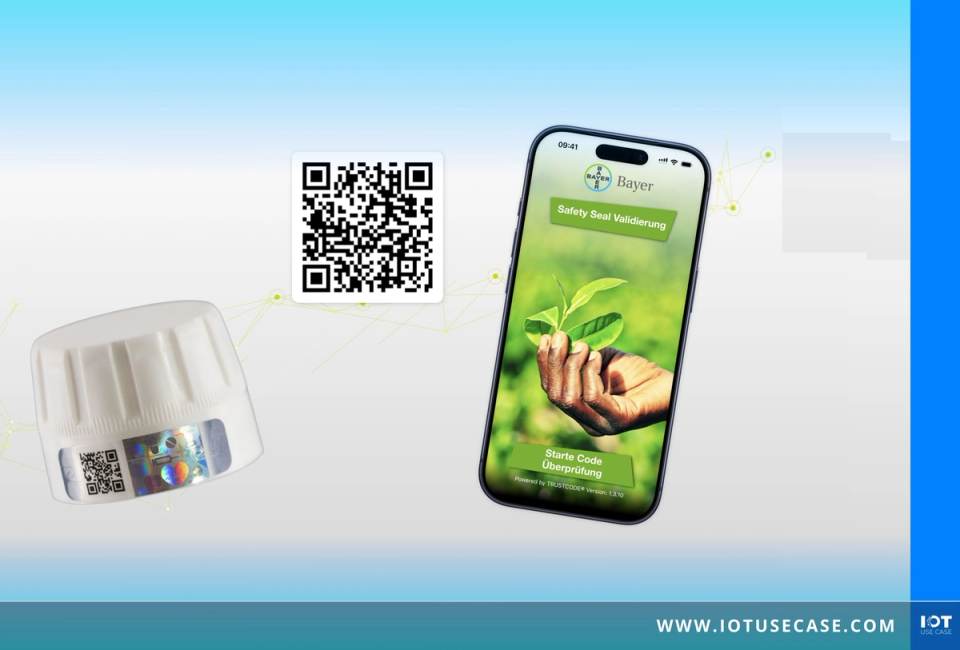


From 2027, the Digital Product Passport (DPP) will become mandatory step by step for products across many industries. Manufacturers will then have to make verified information available directly on the product via QR codes. This turns the DPP into a central building block of manufacturers' product and service processes. The solution from KURZ Digital shows how regulatory requirements can be combined with data integration, service functions, and new digital touchpoints. For around ten years, Bayer CropScience has been using this solution in the field of crop protection in the form of security labels, and for some products, access to additional information is already possible.
The Challenge: The EU Mandate Affects Many Industries
The Digital Product Passport (DPP) is a new EU regulation and will become a mandatory requirement from 2027. The first use cases include steel, textiles, aluminum, tires, furniture, building products, toys, and electronics. The DPP thus affects many value chains, from industrial goods to everyday products.
Digital Identity Bundles Lifecycle Data
The DPP is the digital identity of a physical product. It provides verified data on materials, origin, manufacturing, quality, sustainability, and service throughout its entire lifespan. Access is mandatory via a QR code on the product. After scanning, end customers see sustainability information, instructions, warranty and service details on a website. In the B2B sphere, additional players such as dealers, workshops, and service partners receive more in-depth data.
Beyond end-customer service, the underlying idea of the DPP is the sustainable use of materials and resources. It thereby responds to the EU Ecodesign Regulation (Ecodesign for Sustainable Products Regulation, ESPR), with which the EU aims to achieve a circular economy. Goods are to be tracked throughout their entire lifecycle, making repair, reuse, resale, take-back, refurbishment, and recycling easier. A product passport provides the information needed for this.
Guidelines Provide Orientation for Implementation
The practical introduction of the Digital Product Passport comes with specific conditions. The effort involved, the data model, and the technical implementation are currently being specified by the EU on an industry-by-industry basis. This allows companies to build structures and flexibly adapt their solutions to upcoming requirements.
Central registration bodies and backup providers are also still being defined. In the future, they are intended to help permanently safeguard the availability of the DPP, for example if a company is no longer active on the market. Current product passport solutions are therefore evolving into complex but flexible platforms that will be further expanded in the future in line with new regulatory and technical requirements.
Challenges at a Glance
- •The EU mandate starts in 2027 and gradually reaches many industries.
- •Data models and passport levels are currently being finalized by the EU.
- •Product data is often spread across ERP, PLM, and CRM systems.
- •Availability must remain secured even in the event of a market exit.
The Solution: The Digital Product Passport Connects Compliance and Service
The Service ProductPass PLUS from KURZ Digital is a web-based platform for the unique digital identification of physical products. It goes beyond merely providing the passport and is based on a platform that has been established for years and continuously developed further. As a result, in addition to providing product data, it also offers functions for authenticity verification, Track & Trace, scan analysis, alerts, and gray market detection.
Product Identifiers Provide the Technical Foundation
Concepts similar to product passports already exist for other purposes. For example, some computer manufacturers use stickers with QR codes on their devices that lead to extensive technical information. This makes it easier for dealers and repair businesses to handle the many different devices.
KURZ Digital, too, has had a comparable platform for several years now, one that can verify the authenticity of products, for example using machine-readable codes. The basic technical idea is similar to that of the EU product passport: each product receives a unique identifier for identification.
The QR Code Opens Functions Directly on the Product
Access to the product passport is provided via a QR code. It has to be affixed to the product itself, by means of a security label or a label, and, if desired, additionally on packaging. After scanning, a digital interface with information opens. In addition to predefined mandatory fields, there are also freely configurable, custom data fields. This gives the physical product a digital information space with the following options:
- Scanning the QR code leads to a verified page on which the authenticity of a product is confirmed.
- Consumers receive sustainability information, while service partners receive technical data sheets and repair instructions.
- Track & Trace functions make locations and distribution channels transparent. This makes it possible to detect gray market flows and to make counterfeiting more difficult.
- If a product is only intended to be sold in a specific market, a scan in an unexpected location can trigger an automatic notification, for example by email.
- The scan data shows in which markets the products are used. This gives companies indications of usage patterns and potential anomalies.
- Authorized users can view a change history that documents who made which changes and when.
- It can be used as a digital service booklet in which workshops record work and repairs.
- In addition, further functions can be added that offer added value to the end customer, for example a live video support system.
Interfaces Connect ERP, PIM, and CRM
The platform has been in use for about ten years and is continuously being developed further. Technically, it can be integrated into existing system landscapes via interfaces, for example into ERP, PIM, and CRM systems. A REST API is available for the connection. In addition, customer-specific integrations and CSV imports are possible.
The platform also supports role and permission concepts down to the data field level. In this way, public information for end customers and protected content for workshops, service partners, auditors, or waste disposal companies is provided via the same product passport. By default, it is operated as a hosted platform in KURZ Digital's data center. On request, other operating models such as on-premises or a dedicated cloud instance are also possible.
At KURZ Digital, the introduction of the DPP begins with a consulting phase: in workshops, data structures, existing systems, and requirements are analyzed. Companies receive support with the question of which data they need for the product passport and where this data resides within the company. This consulting is important because the technical platform alone does not solve the data problem. Only when the relevant information is available in a structured form and leaves its silos can the product passport work reliably.
The Result: Compliance with Operational Benefit
With the Digital ProductPass PLUS from KURZ Digital, companies can provide verified product information in a structured way and make it accessible directly on the product. The product passport can thus serve many different information needs. The result is a combination of compliance, transparency, and operational benefit.
For around ten years, Bayer CropScience has been using the solution from KURZ Digital in the field of crop protection. Crop protection products and seeds carry security labels and QR codes that primarily serve brand protection. For some products, additional product information is already available. While this does not fall under the regulation in that sense, it points in the same direction. By now, more than one billion codes are in the system. This demonstrates the platform's ability to manage large volumes of data.
This shows that the product passport helps companies to structure product data and improve its quality. This is where the business value arises. Service processes can be accelerated, repairs documented, and service histories stored. Those who use the product passport strategically can also create new digital touchpoints and unlock after-sales potential through targeted customer engagement.
Results at a Glance
- •Technical foundation for verified product data that is directly available.
- •Role-based access serves different information needs, from end customers to service partners and auditors.
- •Compliance and service functions work hand in hand.
- •Service histories and after-sales processes become digitally mappable.
Learn more here: https://kurzdigital.com/en/solutions/digital-product-passport-plus/