
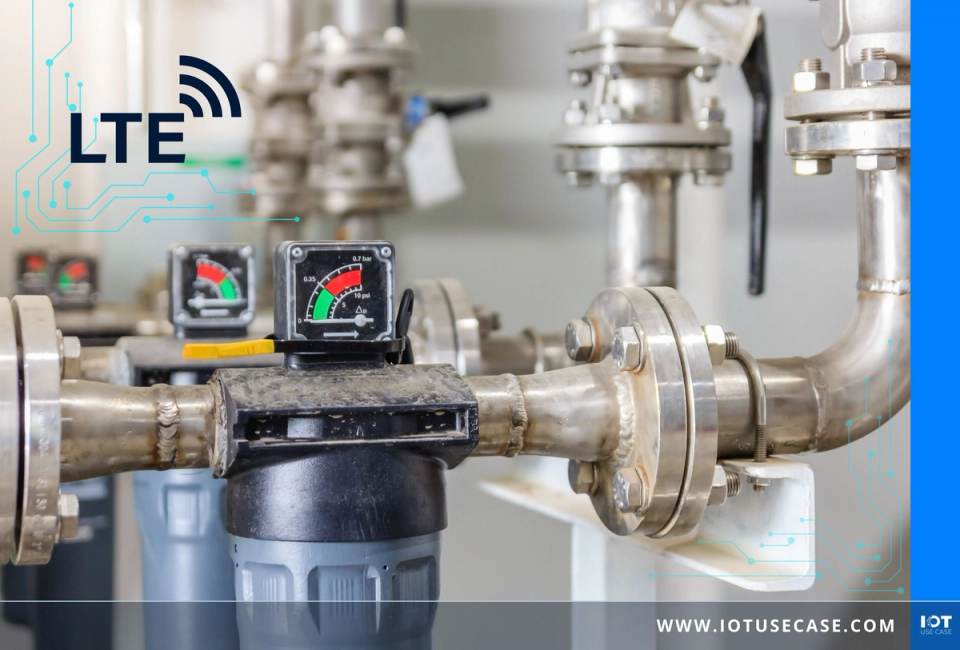


Compressed air is an important but energy-intensive utility in industry. A lack of transparency about actual demand, unnecessarily long compressor run times, excessive operating pressures and undetected leaks drive up energy consumption. An autonomous IoT measurement solution from achtBytes GmbH continuously records the air pressure in the system and transmits the data via a cellular connection for analysis.
Long-term measurements make actual production times, misconfigurations and pressure losses visible. This makes it possible to determine start-up and shutdown times more precisely, better assess the energy efficiency of compressed air and detect leaks earlier. Just a few measuring points provide concrete starting points for energy-efficient operation, without the need for complex integration into the existing IT infrastructure.
The challenge: a lack of transparency drives up energy consumption
Compressed air systems usually provide no precise information on when and to what extent production actually needs compressed air and how much pressure is available. This results in unnecessary compressor run times and a loss of energy. The problem is made worse by leaks that are not always noticed in day-to-day production. Experts at RWTH Aachen University estimate that between 20 and 40 per cent of usable compressed air is lost through leaks. In poorly maintained systems, the figure is said to be as high as 60 per cent. Fixing leaks is therefore an effective way to improve the energy efficiency of compressed air.
Lead times and safety margins cost energy
Another difficulty is the start time of the compressors. Many companies switch them on well before production begins so that the required pressure is built up in time. A similar problem arises at the end of a production day. If actual compressed air demand ends but the compressor keeps running, the system continues to consume energy and thus generates additional costs.
The permanent operating pressure can also waste energy if it is set higher than necessary. However, companies cannot reduce it at will, as certain machines require a minimum pressure. If the pressure drops below this value, the equipment signals a fault. This can disrupt production. That is why those responsible usually choose a high operating pressure with a safety margin.
Spot measurements make control more difficult
Moreover, estimating actual compressed air demand from sporadic spot readings is not very precise. For example, a brief pressure drop can be caused by an open valve or an additional consumer. It does not mean that the operating pressure is permanently too low. Without continuous readings, however, this distinction is difficult to make, which is why in practice the operating pressure is set permanently too high as a precaution.
Compressed air systems should be permanently monitored and regularly checked to avoid unnecessary energy costs. However, this involves considerable manual effort that requires additional staff. An alternative is monitoring with IoT technologies, which allow data collection and analysis to be largely automated.
Challenges at a glance
- •Lack of real-time data on compressed air demand and compressed air energy efficiency.
- •Energy losses due to leaks, unnecessary run times and excessive operating pressure.
- •Misconfigurations and special operating times that remain in place permanently.
- •High manual effort for monitoring, analysis and optimisation.
The solution: autonomous IoT measurement makes compressed air demand visible
The LTE-based industrial IoT solution from achtBytes GmbH provides a measurement method that reveals actual compressed air demand, unnecessary compressor run time, excessive pressure values and leaks. This enables companies to improve the energy efficiency of their compressed air. Unlike the previous IO-Link solution, the new version requires no additional master, edge box or coordination with IT. It is therefore independent of the local IT infrastructure and does not involve a high integration effort.
An IoT sensor continuously records the pressure
At the heart of the solution is an autonomously operating sensor that is integrated directly into the compressed air system. It continuously measures the pressure and transmits the readings via its own cellular connection to the associated platform. It therefore does not need to be connected to the existing corporate network.
The hardware effort remains low. In an interconnected compressed air ring main, a single sensor is sufficient. Separate compressed air systems and distinct sites each require their own sensor. However, comprehensive coverage with a large number of measuring points is not necessary.
Installation takes just a few minutes. The sensor simply needs to be fitted into the compressed air line at a suitable point. In addition, it requires a power supply and cellular reception. Overall, installing the sensors is also suitable as an apprentice training project, as no in-depth technical knowledge is required. Almost any employee can install the sensor.
LTE transmits measurement data independently of the company network
Every achtBytes sensor is equipped with a suitable SIM card and operates via an available LTE cellular connection. Companies therefore need neither a separate mobile contract nor separate SIM card management. Thanks to the almost Europe-wide coverage and performance of the LTE network, the sensors work at all typical locations of compressed air systems.
The connection uses only a small amount of bandwidth, as the sensor merely transmits individual telemetry values every few seconds. One note: in deep basements or heavily shielded parts of buildings, deployment may theoretically be more difficult. In practice, however, this is rarely a problem.
Long-term data optimises operating times and leak control
The achtBytes solution continuously records the pressure curve and uses it to create a profile. It shows the minimum required operating pressure as well as pressure losses. The platform also determines when production actually needs compressed air and when there is no demand. This makes it easy to improve the start and end times of the compressed air system:
- Start time: The platform analyses the run-up time of the entire compressed air system and compares it with the point at which compressed air is actually needed. Together, the two values give a sensible start time.
- End time: The sensor data shows until when the machines actually need compressed air. This allows the compressor's shutdown time to be determined precisely.
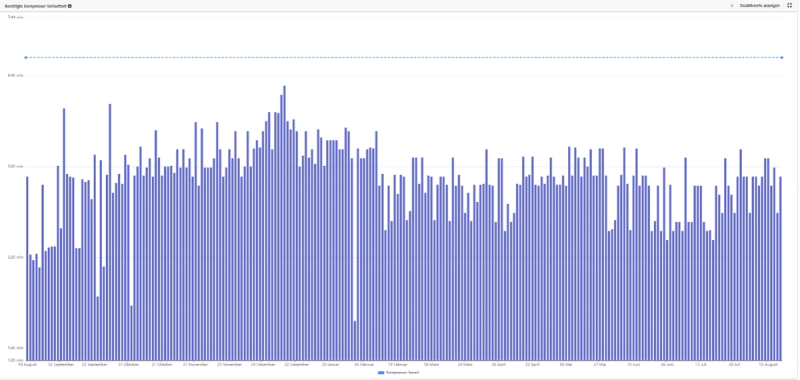
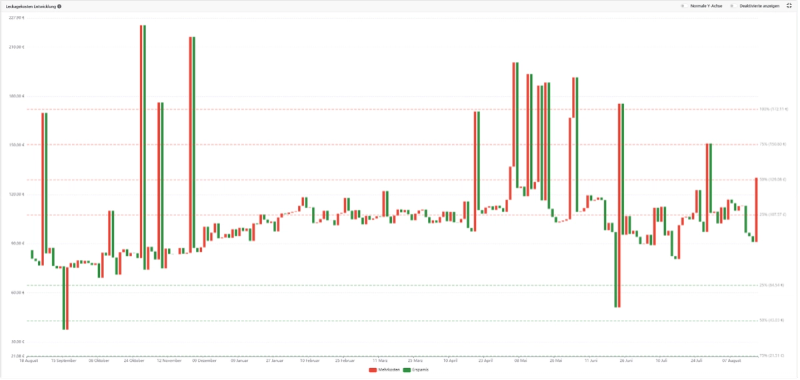
The system stores all readings over the long term, which produces reference values. As a result, regular patterns become recognisable and deviations are noticed more quickly. The solution also shows how large the losses from leaks are and how they develop over time. What matters here is the daily extrapolation to actual energy costs. This enables management to decide when a detailed search for existing leaks is worthwhile. However, the sensor cannot determine exactly where the leak is. It therefore does not replace a manual leak search.
The platform of the achtBytes solution offers visualisation and dashboard functions in which start and end times, pressure curves, minimum values and the development of leaks can be viewed. In individual dashboards, for example, a company's individual compressed air ring mains can be displayed graphically and linked to the respective pressure values. An alarm function complements this visualisation. Thresholds can be entered in the platform at which it issues a warning.
The result: measurement data shortens run times and reduces energy losses
The measurement results lead to concrete optimisations, for example at a German company with a production site in Hungary. It monitors its energy costs EU-wide from its headquarters. This also includes the compressed air systems. A few examples show how the achtBytes solution reduces energy losses.
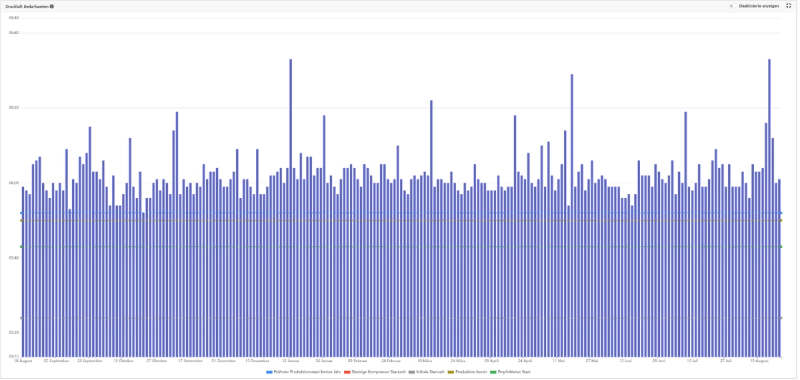
In one compressed air system, the compressor needed six minutes and 40 seconds to build up the required pressure. Production starts at 6:00 a.m., which is why the usual start at 5:30 a.m. is unnecessarily early. This specific individual case results in a potential saving of more than 20 minutes of compressor run time.
A long-term analysis of another system revealed the effects of a misconfiguration of the compressed air system. A compressor was supposed to start at 5:50 a.m., but actually began operating at 5:20 a.m. The reason was an internal lead time of 30 minutes stored in the device. The long-term data also showed that this start time moved forward by a further minute week after week – a creeping effect that would have gone unnoticed without continuous measurement.
This shows that even a small installation of the achtBytes solution can deliver detailed insights into the operation of a compressed air system. Even a single sensor on a ring main can create the data basis for optimisation and cost savings. Continuous visualisation also has an organisational benefit. It makes energy consumption visible and ensures that employees and those responsible engage more closely with the compressed air supply.
Companies thus achieve a high level of transparency in their compressed air system. Long-term data shows the minimum values during productive operation. This makes it easier to assess whether an existing setpoint is higher than necessary. At the same time, companies can take limit values and safety buffers into account without affecting production.
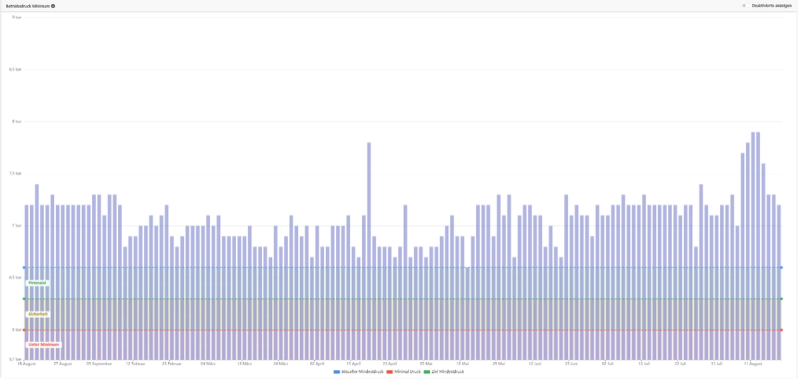
The most important advantage is the technical independence of the achtBytes solution. It neither has to be integrated into internal IT systems nor installed locally. It can also be used across sites and throughout Europe. This gives companies a simple way to capture data from different production sites centrally and analyse it in dashboards. This data yields concrete starting points for energy savings and maintenance decisions.
Results at a glance
- •Transparency on actual compressed air demand and real production times.
- •Optimised compressor run times thanks to more precise start and shutdown points.
- •Earlier detection of leaks and optimum operating pressure.
- •Cross-site analysis without integration into local IT systems.