

Nut (food)
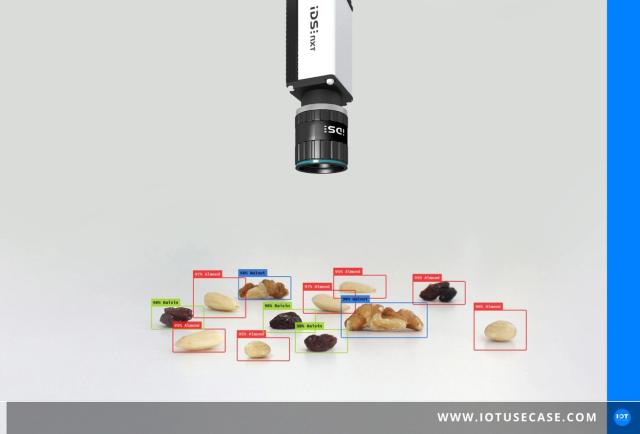
In nut processing, an AI camera checks during packing whether every nut and every mix meets the specification. The producer detects incorrect proportions and defective nuts without sorting, counting or weighing by hand beforehand.
Nut (food) at a glance
Most frequent in the solution examples on this page
Use cases
Technologies
Solution examples featuring Nut (food)



Nut processing: quality control with an AI camera
In the solution example, IDS Imaging Development Systems uses its IDS NXT industrial camera. The user takes around 50 images of each type of nut in different shapes, positions and quantities. A product expert marks defective nuts, a step known as labelling. The images are sent to the cloud via the Vision App, where the camera's neural network is trained. The user needs no AI expertise for this, product knowledge is enough. The camera communicates with devices, machines and services via OPC UA without an intermediate PC. A dashboard shows the evaluations, for example the error rate in nut sorting.
The use case is complete inspection in production. The challenge: nuts are organic products and vary widely in shape and colour, unlike screws, where any deviation indicates a defect. In the example, the camera was to check whether the bag really contains the specified proportion of walnuts or almonds. Because cost pressure in the food industry is high, IDS offers a semi-automated solution alongside the fully automated one. According to the source, the solution can be implemented in-house, an additional visual check remains possible, and images and evaluations are documented.
Nut processing: frequently asked questions
How does an AI camera support a nut sorting machine?
An AI camera sorts nuts with a neural network trained on images of each type of nut. In the IDS example, the user takes around 50 images per nut type and marks defective nuts. The IDS NXT then classifies each nut itself, even when shape and colour differ widely. A dashboard shows the error rate continuously.
Why is nut quality control difficult?
Nuts are organic products that vary widely in shape and colour. Conventional sorting and inspection systems are designed for almost identical parts, where any deviation indicates a defect, as in screw production. With nuts, this does not work. IDS calls them highly variable organic objects and therefore relies on a camera with a trained neural network.
How is the mix checked during nut packaging?
During packing, the camera checks whether each type of nut is present in the specified proportion. In the IDS example, the IDS NXT was to determine whether the bag really contains the defined proportion of walnuts or almonds. To do this, it recognises each type of nut as a separate object class. Images and evaluations are documented, and an additional visual check remains possible.
Do you need AI experts for walnut sorting?
No, product knowledge is enough for training, and according to IDS no AI expertise is needed. The user takes images of the walnuts, a product expert labels defective ones, and the Vision App trains the network in the cloud. The software assists with post-processing the images, for example brightening or realigning them. This allows the solution to be implemented in-house.
More assets in “Piece Goods / Bulk Material”

Parcel
Parcel sorting with IoT starts in goods receiving, where sensors capture each parcel’s tracking number, size and weight. Shipments are routed by priority, packing teams know early what is coming, and manual scanning ends.

Workpiece
Manufacturing traceability assigns each workpiece its identifier, its position and all process and inspection data. Manufacturers can thus document every work step and detect quality deviations before scrap is produced.

Printed circuit board
PCB manufacturing digitalisation connects machines, controllers and the ERP so that every printed circuit board is produced with the right parameters. Manufacturers detect downtime and bottlenecks, avoid operating errors and give customers the production data they ask for.

Raw material batch
Batch management with IoT links every raw material batch to weighing data, test results and the production order. When deviations or audits occur, manufacturers see at once which batch went into which product instead of searching paper and Excel files.

Goods in transit
Cargo theft prevention starts with IoT trackers that report the position, temperature and shocks of goods in transit. They show shippers at all times where their goods are and reveal break-in attempts, delays or problems in the cold chain.

Injection-moulded part
Injection moulding defects often show up in cooling and process data before they become visible on the moulded part. IoT continuously records mould temperature, cooling water and machine data so that deviations are noticed before faulty parts are produced.
IIoT Use Case user group
What no solution example tells you
What did the project cost? Which sensor didn't survive in the field? How did you get maintenance on board? 300+ industrial users discuss questions like these with each other every month, openly and without vendors in the room.
Frequent topics in these examples, bring your questions:
- Quality Management
Online every month
Alternating tech and business focus
Users only
No sales pitches, exchange under NDA
300+ members
OT, IT and IIoT leads from industry