






In many manufacturing facilities, IO-Link-capable sensors and actuators are already installed. In most cases, however, only the switching and analog outputs are used, while the additionally available diagnostic and status data remain untapped in the plant. As a result, there is no reliable data basis for applications such as condition monitoring, predictive maintenance or AI-based anomaly detection.
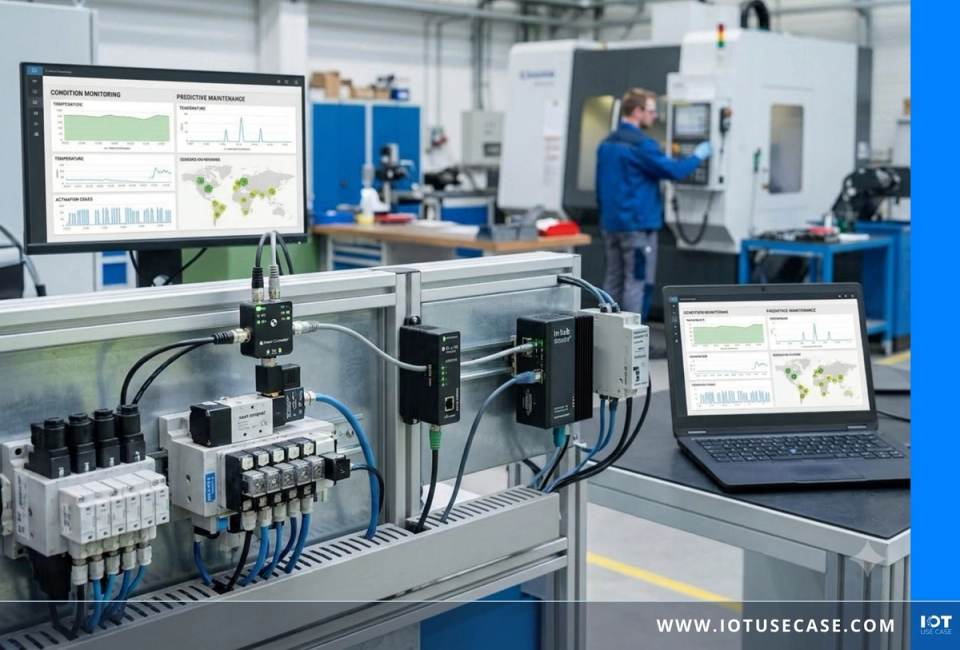
nass magnet and in.hub address this gap together. nass magnet comes from the world of electromagnetic components for pneumatic applications and provides the field level: an IO-Link-capable Smart Connector for solenoid coils and valves, as well as an Ethernet master that forwards the IO-Link data in an IoT-ready form. With its Linux-based operating system siineos®, in.hub contributes the edge and integration layer, in which the data is normalized, stored and made available via services. This creates an end-to-end data pipeline from the sensor to the IT level.
The challenge: Turning existing IO-Link data into a usable data basis
IO-Link is a standardized communication system that connects sensors and actuators to the automation or IoT level via a simple point-to-point connection, transmitting device parameters, status data and diagnostics. In practice, however, this potential is rarely fully exploited. Putting such data to reliable use involves several requirements that are less technical than organizational and structural in nature:
- Unclear objectives: Without a clearly defined goal – such as alerting, reporting, OEE or energy analyses – it remains open which data is needed and in what form.
- Involving the right stakeholders: Projects like these only gain traction when the relevant people from OT and IT come together early on and a benefit becomes apparent from several directions.
- Load on the control system: If status data is routed through the machine controller, this increases the control-system load, even though the data is not needed in the controller for diagnostic purposes.
- Semantics towards IT: Connectivity alone is not enough. For IO-Link data to be combined with other data and evaluated, it has to be available in a defined structure.
What was needed, therefore, was a way to capture the existing IO-Link data, normalize it and make it available for condition monitoring and further analyses.
The solution: An IO-Link master in the field and an edge operating system for data processing
nass magnet starts at the field level. The Smart Connector is a connector with condition monitoring functions and an IO-Link interface that sits directly on the solenoid coil of a pneumatic valve and captures measurement data there. The Ethernet master from nass magnet forms the bridge between IO-Link sensors and actuators and the IoT systems: it translates the measured data into IoT-ready protocols and forwards it via Ethernet. What matters for further processing is that the nass magnet master passes the data on largely unfiltered, so that it can then be evaluated freely.
in.hub handles the data processing with its siineos operating system. In siineos, both the nass magnet master and the IO-Link devices behind it can be configured without any programming. This eliminates the need to switch between different configuration tools during a project. For the semantics of the IO-Link devices, in.hub uses the IODD, the description file of the sensor, process and parameter data: an IODD interpreter imports the file and stores it as a device driver in siineos. In addition, device manufacturers can provide driver files via an online portal.
Architecturally, the pre-processing takes place on the edge device. The data – regardless of whether it originates from discrete inputs and outputs, from other protocols or from IO-Link – is normalized and written to a database on the edge; the user selects which of the numerous IO-Link values are stored and at what frequency. On this data basis, various microservices run in siineos, for example a Grafana dashboard, an alerting tool, cloud connectors and an SQL connector for connecting to a company's own SQL database. The data is pre-processed and formatted within siineos; for the structured handover to the IT systems, OPC UA and MQTT are then available. Processing deliberately takes place alongside the control system in order to leave the ongoing processes untouched; if required, in.hub can nevertheless build a bridge into the control domain via siineos, for example to send messages to the operator panel.
Because the tools used – normalizing values, writing to the database, setting up services – are identical for every project and are parameterized by the user themselves, there is no need to develop a new application for each use case.
The result: A usable data basis for condition monitoring without additional load on the control system
Through the interplay of the IO-Link master and the edge operating system, the previously untapped IO-Link diagnostic data can be captured, normalized and made available for analysis. nass magnet supplies the structured data in the field, and in.hub turns it into a usable data basis and provides condition monitoring functions with visualization on top of it.
Because the data is captured directly in the field and processed on the edge, the control system is not additionally burdened and the ongoing processes remain untouched. Configuration without programming effort and the uniform toolkit in siineos shorten project lead times, so that retrofit projects move into operation more quickly. Normalized data and defined interfaces also create a scalable data basis that can be extended across further sensors, machines and applications such as OEE and energy analyses.
A specific end-customer case with solid metrics is currently still being worked out jointly; quantified KPIs on savings or reduced downtime are therefore not yet available for this partnership.
Outlook: Expanding the field devices and the integration layer
Both partners are continuing to expand their offering. nass magnet is preparing a multi-protocol master and has further field devices in the pipeline, including an IO-Link hub with functions similar to the Smart Connector as well as connectors for controlling proportional valves with IO-Link technology. In addition, nass magnet is using its IoT master to address new fields of application such as building automation and intralogistics.
in.hub is expanding its integration layer, among other things with the SQL connector, which allows companies' own SQL databases to be written to directly, as well as with the online portal for prepared device driver files. With the decentralized HUB-SE100 module, in.hub moves closer to the sensor: it can be inserted directly into the sensor line on the machine, digitizes the signal close to the sensor and thus further simplifies retrofit projects.