IT/OT Integration
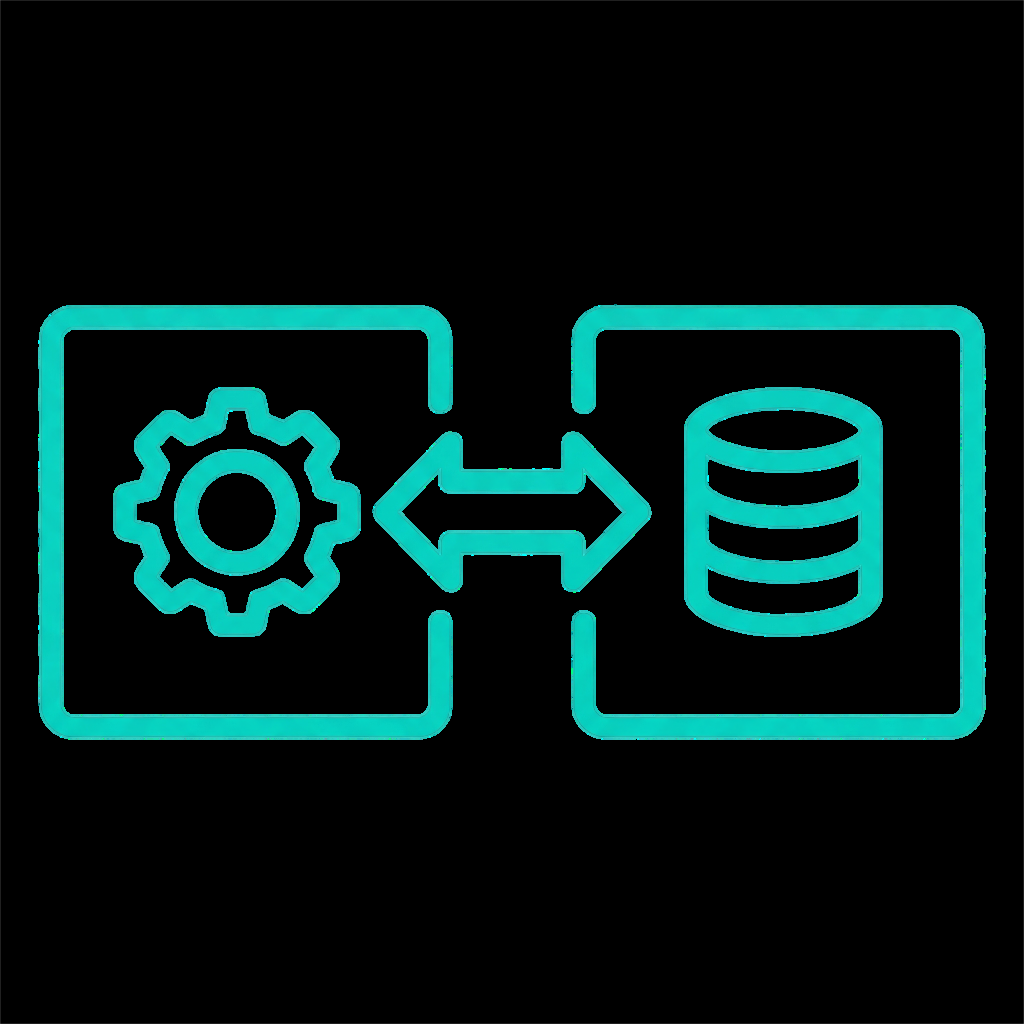
IT/OT integration describes the technical connection of operational technology – i.e., controllers, machines, sensors, and SCADA systems – with information technology such as ERP, MES, cloud platforms, and data lakes. The goal is a seamless data flow without media breaks between the shopfloor and higher-level enterprise systems.
In practice, it is not just about technical connectivity, but about the strategic convergence of both worlds – also called IT/OT convergence. While integration enables the pure data flow (“How does data get from the machine to IT?”), convergence describes the organizational shift: shared governance, aligned security concepts, and unified technology stacks.
Successful companies like Schaeffler have demonstrated this: more than 10,000 machines in 70 plants worldwide are connected via a unified messaging infrastructure. Machines are connected once, data is uniformly structured, and usable in many ways – for OEE analysis, CO₂ calculations, condition monitoring, and more, without additional hardware or duplicate integrations.
Where does IT/OT integration create concrete value?
These use cases are implemented in real projects from our network – based on clean, one-time machine connectivity.
OEE analysis and production optimization
Machine status, cycle times, and downtime reasons from OT are linked with order data from MES – the basis for reliable OEE metrics and bottleneck analysis.
CO₂ and energy consumption at machine level
Energy meters and machine data are directly connected to IT systems – for granular ESG reporting, Scope 3 analyses, and efficiency programs at site level.
Predictive maintenance and condition monitoring
Vibration, temperature, and pressure data from OT flows into analytics platforms – anomalies are detected before failures occur. Maintenance becomes plannable rather than reactive.
Quality management and traceability
Process parameters are seamlessly linked with batch and product data from ERP and MES. Quality deviations can be traced back step by step.
Intralogistics and automated material flow
AGVs, conveyor systems, and storage systems are synchronized with higher-level IT systems – just-in-sequence delivery, inventory management, and transport planning in real time.
Remote maintenance and remote support
Machines are remotely monitored, parameterized, and maintained via secure connections – without on-site visits. Service response times drop dramatically.
Connecting brownfield – the typical hurdles in practice
In many plants, old control technology meets ambitious digitalization goals. These are the challenges we encounter most frequently.
Heterogeneous machine parks from different decades
Machines from the 1970s run alongside systems from 2023. Some communicate via OPC UA, others not at all. Unified connectivity requires well-thought-out connectivity strategies.
Data silos and media breaks
OT data is captured locally but not used across systems. ERP knows nothing of machine status, MES nothing of energy consumption – manual data transfer is the norm.
Lack of internal standards and governance
Without defined technology stacks, deployment concepts, and responsibilities, a patchwork of isolated solutions emerges. Each department solves the same problem differently.
OT security as a blind spot
Direct connections between machine controllers and IT systems open new attack vectors. OT networks were historically air-gapped – security measures for connected environments are often missing.
Organizational separation of IT and OT
IT and OT managers speak different languages and have different priorities. Without a shared platform strategy, both sides block each other.
What does clean IT/OT integration deliver as a foundation?
Companies that connect cleanly once and then scale achieve measurably better results than those connecting use case by use case individually.
Collect data once, use it many times
A single, clean machine connection is the foundation for all downstream use cases. OEE, energy, predictive maintenance, and AI analytics all build on the same data foundation.
Scalability without architectural changes
New use cases can be realized on existing infrastructure – without additional hardware, new interfaces, or duplicate connections. Time and cost for new projects decrease.
IT relief through standardized infrastructure
Clear standards for deployment, protocols, and data models reduce operational effort and avoid the patchwork of individual interface solutions.
Foundation for AI and data-driven optimization
AI models need large, consistent datasets. Seamless IT/OT integration provides the data foundation on which predictive algorithms and ML models can be meaningfully trained.
Transparency across all sites and plants
Unified data infrastructure enables cross-site benchmarks, global dashboards, and consolidated reporting – without manual data consolidation.
Increased OT security through structured architecture
Defined network segmentation, DMZ concepts, and secure protocols protect OT systems from cyberattacks – and meet NIS2 and Cyber Resilience Act requirements.
Our experts for IT/OT Integration
These companies successfully use IT/OT Integration.